Specified regulatory authority income receives conditional tax exemption, subject to non-commercial activity, unchanged income character, and return f...
Tax exemption for regulatory authority income applies retrospectively, subject to non-commercial activity, unchanged income sources, and return-filing...
Input tax credit conditions remain constitutionally valid, with eligible recipient claims considered under GST circulars and retrospective filing dead...
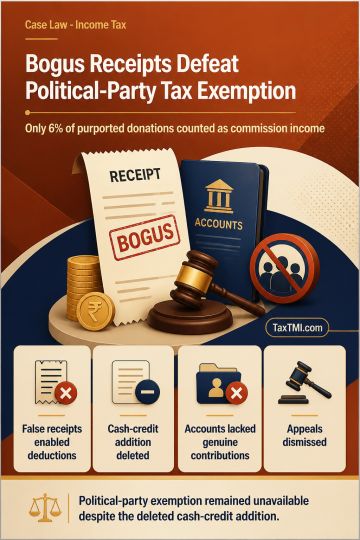
Bogus donation receipts justified commission income assessment and defeated political-party tax exemption for inaccurate accounts and reporting failur...
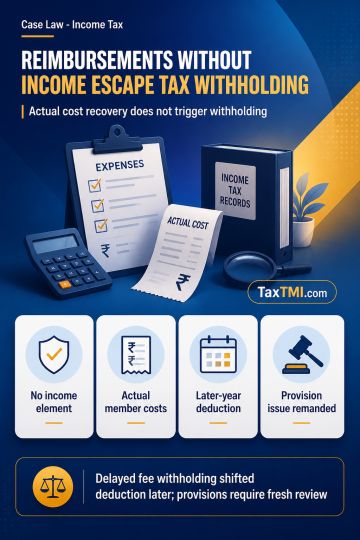
Pure reimbursement without income element escapes tax withholding, while delayed withholding and unsupported provisions face deferred or renewed scrut...
Public benefit requirement defeats charitable registration where residents' association services are reciprocal, member-only facilities governed by mu...
CESTAT adjudicated a complex excise duty dispute involving multiple product classifications and credit claims. The tribunal partially allowed the appeal, holding that: (1) CENVAT credit on input materials for Baking Powder is permissible even prior to registration; (2) Custard Powder qualifies for concessional 1% and 2% duty rates; (3) Corn Flour was incorrectly classified as maize starch and the corresponding duty demand was set aside; (4) The allegation of intentional duty evasion was not sustainable; (5) The extended limitation period was not invokable; and (6) Penalties against the firm and its partner were consequently quashed. The appellant remains liable for excise duties on Baking Powder, Custard Powder, Icing Sugar, and Drinking Chocolate, with specific concessional rate entitlements.
CESTAT adjudicated a complex excise duty dispute involving multiple product classifications and credit claims. The tribunal partially allowed the appeal, holding that: (1) CENVAT credit on input materials for Baking Powder is permissible even prior to registration; (2) Custard Powder qualifies for concessional 1% and 2% duty rates; (3) Corn Flour was incorrectly classified as maize starch and the corresponding duty demand was set aside; (4) The allegation of intentional duty evasion was not sustainable; (5) The extended limitation period was not invokable; and (6) Penalties against the firm and its partner were consequently quashed. The appellant remains liable for excise duties on Baking Powder, Custard Powder, Icing Sugar, and Drinking Chocolate, with specific concessional rate entitlements.
Note: It is a system-generated summary and is for quick reference only.
 TaxTMI
 of 4801


















 Join Channel


 TaxTMI
