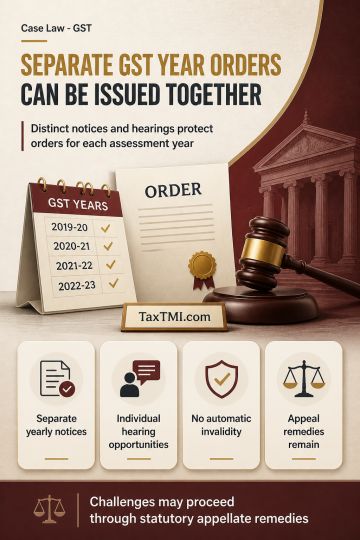
Separate assessment orders for different years remain valid when distinct notices and hearing opportunities prevent prejudice from combined proceeding...
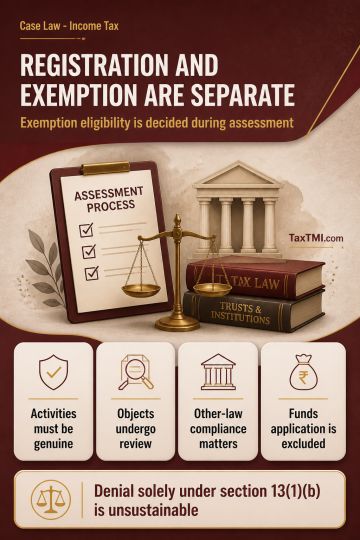
Defined public benefit can retain charitable character; registration renewal requires examining genuine activities and legal compliance, not surplus a...
Capital reduction is distinct from share buy-back, preventing buy-back tax; restructuring interest and related business deductions also survive scruti...
Transfer pricing and tax deductions upheld on established principles, while employee contributions and warranty provisions returned for fresh examinat...
Page of 4803
Press 'Enter' after typing page number.
1201 to 1220 of 96046 Results
❮
❯
❯❯
0 / 200
Expand Note
Add to Folder
No Folders have been created
+
Are you sure you want to delete "My most important" ?
AAR determined that medicines and consumables supplied to in-patients as part of healthcare services constitute a composite supply exempt from GST. The services, including medical, pharmaceutical, and paramedical interventions from admission to discharge, are classified under inpatient services. The hospital, as a clinical establishment providing healthcare under medical direction, qualifies for exemption under Notification No. 12/2017-CT(Rate). The supply of medicines and consumables to in-patients is naturally bundled with principal healthcare services and therefore considered a single composite supply, rendering the entire service tax-exempt. Notably, this exemption applies specifically to in-patient services and differs from out-patient medical supply treatments.
AAR determined that medicines and consumables supplied to in-patients as part of healthcare services constitute a composite supply exempt from GST. The services, including medical, pharmaceutical, and paramedical interventions from admission to discharge, are classified under inpatient services. The hospital, as a clinical establishment providing healthcare under medical direction, qualifies for exemption under Notification No. 12/2017-CT(Rate). The supply of medicines and consumables to in-patients is naturally bundled with principal healthcare services and therefore considered a single composite supply, rendering the entire service tax-exempt. Notably, this exemption applies specifically to in-patient services and differs from out-patient medical supply treatments.
Note: It is a system-generated summary and is for quick reference only.
 TaxTMI
 of 4803












 Join Channel


 TaxTMI

