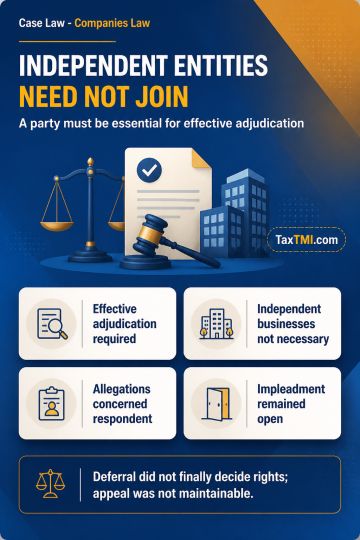
Necessary-party requirements limit impleadment of independent entities, while deferred consideration does not create an appealable adverse determinati...
Food supplement classification requires common parlance and authoritative tests, preventing treatment as proprietary Ayurvedic medicines without suppo...
Specified regulatory authority income receives conditional tax exemption, subject to non-commercial activity, unchanged income character, and return f...
Tax exemption for regulatory authority income applies retrospectively, subject to non-commercial activity, unchanged income sources, and return-filing...
ITAT allowed the appeal, setting aside both AO and CIT(A) orders due to procedural irregularities. The appellate authority failed to adjudicate issues on merits as mandated under Section 250(6), and the AO made additions without substantive inquiry into expense claims. The tribunal found no specific defects in the assessee's expense documentation and determined that neither the assessment order nor the appellate order was legally sustainable. The matter was remanded to the AO for a de novo assessment, with the appeal allowed for statistical purposes, ensuring a comprehensive re-examination of the original expense claims and proportionate calculations.
ITAT allowed the appeal, setting aside both AO and CIT(A) orders due to procedural irregularities. The appellate authority failed to adjudicate issues on merits as mandated under Section 250(6), and the AO made additions without substantive inquiry into expense claims. The tribunal found no specific defects in the assessee's expense documentation and determined that neither the assessment order nor the appellate order was legally sustainable. The matter was remanded to the AO for a de novo assessment, with the appeal allowed for statistical purposes, ensuring a comprehensive re-examination of the original expense claims and proportionate calculations.
Note: It is a system-generated summary and is for quick reference only.
 TaxTMI
 of 4798















 Join Channel


 TaxTMI

