Authentication of paper assessment orders upheld, while qualifying repairs, consumables and vendor advance write-offs remain deductible business claim...
Transaction value cannot be rejected solely on non-statutory valuation guidelines without corroborative evidence supporting reassessment of final cust...
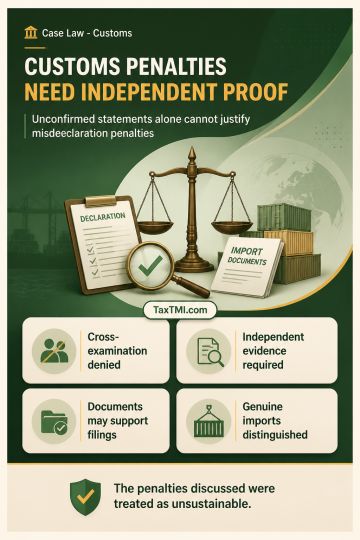
Cross-examination rights and corroborated evidence limit customs penalties for misdeclaration in genuine import transactions involving documented clea...
Tariff classification of vehicle gear components follows the specific gearing entry, displacing motor-vehicle parts classification and related liabili...
Page of 4786
Press 'Enter' after typing page number.
381 to 400 of 95715 Results
❮
❯
❯❯
0 / 200
Expand Note
Add to Folder
No Folders have been created
+
Are you sure you want to delete "My most important" ?
ITAT adjudicated two key tax matters involving a taxpayer's ULIP policy and residential property capital gains. The tribunal held that the LIC Market Plus-1 Policy constitutes a capital asset, rendering gains from its surrender taxable under "Capital Gains" rather than "Income from Other Sources". Additionally, the tribunal ruled that capital gains from multiple residential property sales can be invested in a single residential property, allowing the taxpayer's exemption claim under section 54. The tribunal found the assessee complied with statutory requirements by constructing a new house within three years and depositing capital gains in a prescribed scheme account. Consequently, the tribunal allowed the assessee's appeals, directing the Assessing Officer to grant the claimed section 54 exemption and recognize the capital gains treatment for the ULIP policy surrender.
ITAT adjudicated two key tax matters involving a taxpayer's ULIP policy and residential property capital gains. The tribunal held that the LIC Market Plus-1 Policy constitutes a capital asset, rendering gains from its surrender taxable under "Capital Gains" rather than "Income from Other Sources". Additionally, the tribunal ruled that capital gains from multiple residential property sales can be invested in a single residential property, allowing the taxpayer's exemption claim under section 54. The tribunal found the assessee complied with statutory requirements by constructing a new house within three years and depositing capital gains in a prescribed scheme account. Consequently, the tribunal allowed the assessee's appeals, directing the Assessing Officer to grant the claimed section 54 exemption and recognize the capital gains treatment for the ULIP policy surrender.
Note: It is a system-generated summary and is for quick reference only.
 TaxTMI
 of 4786

















 Join Channel


 TaxTMI