CENVAT credit for trading requires reversal, while taxable-service rental credit remains proportionately available and limitation issues await resolut...
Vicarious liability for dishonoured company cheques may extend to non-signatory directors where complaints contain foundational responsibility avermen...
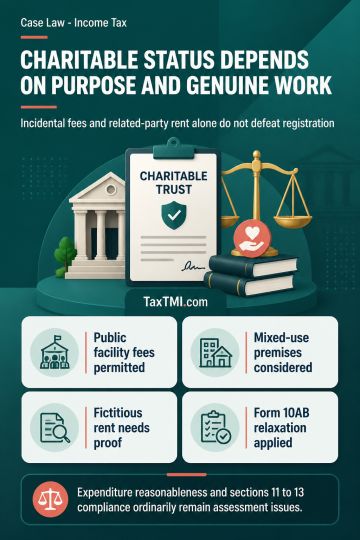
Charitable registration turns on predominant purpose and genuine activities, while incidental fees and related-party rent require supporting adverse m...
MAT book-profit adjustments exclude disallowances for exempt-income expenditure and demerger expenditure unless expressly listed under the statutory c...
Page of 4790
Press 'Enter' after typing page number.
41 to 60 of 95794 Results
❮
❯
❯❯
0 / 200
Expand Note
Add to Folder
No Folders have been created
+
Are you sure you want to delete "My most important" ?
ITAT adjudicated multiple taxation issues, primarily focusing on income computation and disallowances. The tribunal substantially upheld the CIT(A)'s findings, rejecting revenue's contentions across several grounds. Key determinations included: (1) rejecting selective interpretation of audit reports, (2) directing verification of EPF/ECGI disallowances, (3) declining interference with stock shrinkage claims in petroleum sales, (4) rejecting revenue's attempt to tax government loans after 10 years, and (5) maintaining consistent accounting practices. The tribunal emphasized holistic evaluation of financial records, adherence to established accounting principles, and rejected revenue's piecemeal approach to income assessment. Most revenue grounds were dismissed, preserving the assessee's original tax computations.
ITAT adjudicated multiple taxation issues, primarily focusing on income computation and disallowances. The tribunal substantially upheld the CIT(A)'s findings, rejecting revenue's contentions across several grounds. Key determinations included: (1) rejecting selective interpretation of audit reports, (2) directing verification of EPF/ECGI disallowances, (3) declining interference with stock shrinkage claims in petroleum sales, (4) rejecting revenue's attempt to tax government loans after 10 years, and (5) maintaining consistent accounting practices. The tribunal emphasized holistic evaluation of financial records, adherence to established accounting principles, and rejected revenue's piecemeal approach to income assessment. Most revenue grounds were dismissed, preserving the assessee's original tax computations.
Note: It is a system-generated summary and is for quick reference only.
 TaxTMI
 of 4790







 Join Channel


 TaxTMI