Inherited property sale proceeds require capital-gains treatment where ownership is supported by evidence, not suspicion or unverified signature doubt...
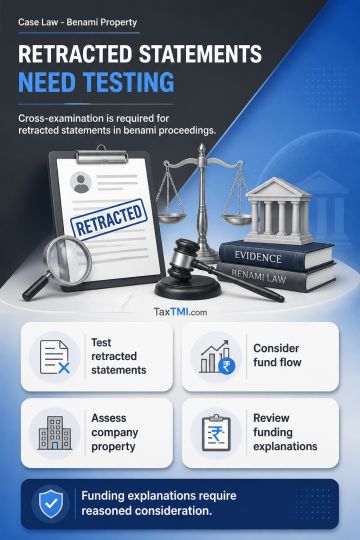
Cross-examination of retracted statements is essential where foundational evidence supports a benami allegation and documented funding explanations re...
Capital-goods exemption covers plant-modernisation accessories, while the import restriction applies only to earlier capital-goods components and spar...
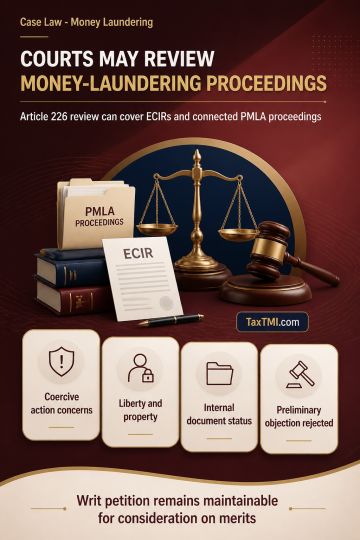
Constitutional judicial review permits challenges to ECIRs and connected money-laundering proceedings where coercive action affects fundamental intere...
HC adjudicated a GST penalty case involving non-completion of e-way bill part-B. The court determined that mere technical non-compliance with Rule 138 regarding e-way bill documentation does not automatically justify penalty assessment under Section 129. Without substantive evidence demonstrating a deliberate tax evasion attempt, the administrative order imposing penalty was deemed unsustainable. Consequently, the HC set aside the Assistant Commissioner's penalty order, effectively ruling that procedural omissions alone cannot trigger punitive fiscal measures without proving intentional tax avoidance.
HC adjudicated a GST penalty case involving non-completion of e-way bill part-B. The court determined that mere technical non-compliance with Rule 138 regarding e-way bill documentation does not automatically justify penalty assessment under Section 129. Without substantive evidence demonstrating a deliberate tax evasion attempt, the administrative order imposing penalty was deemed unsustainable. Consequently, the HC set aside the Assistant Commissioner's penalty order, effectively ruling that procedural omissions alone cannot trigger punitive fiscal measures without proving intentional tax avoidance.
Note: It is a system-generated summary and is for quick reference only.
 TaxTMI
 of 4805













 Join Channel


 TaxTMI