Opportunity to respond to jurisdictional reports is mandatory before customs settlement duty enhancement; connected applications require consistent ad...
Specific customs headings for scaffolding components prevail over general classification, invalidating misclassification proceedings and enabling with...
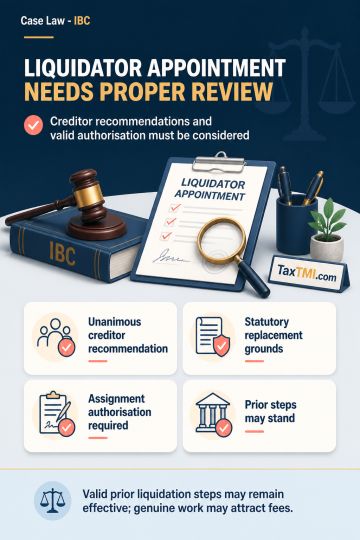
Liquidator appointment under Section 34 requires consideration of creditor recommendations, valid professional authorisation, and preservation of vali...
Income-tax exemption for specified regulatory fees and government grants applies subject to non-commercial activity and continuing compliance conditio...
Digital accessibility audit and remediation deadlines extended, while all other disability-compliance obligations for regulated entities remain unchan...
Page of 4803
Press 'Enter' after typing page number.
621 to 640 of 96047 Results
❮
❯
❯❯
0 / 200
Expand Note
Add to Folder
No Folders have been created
+
Are you sure you want to delete "My most important" ?
ITAT adjudicated a tax dispute regarding penalty u/s 271(1)(c), finding no justification for penalty imposition. The tribunal determined that returned income matched assessed income, and no substantive evidence of income concealment existed. The show cause notice lacked specific allegations of tax evasion or inaccurate income particulars. Given the absence of procedural fairness and no demonstrable intent to evade tax, the tribunal deleted the 100% penalty. The decision hinged on procedural defects and lack of clear evidence of deliberate tax non-compliance, ultimately ruling in favor of the assessee based on principles of natural justice and procedural propriety.
ITAT adjudicated a tax dispute regarding penalty u/s 271(1)(c), finding no justification for penalty imposition. The tribunal determined that returned income matched assessed income, and no substantive evidence of income concealment existed. The show cause notice lacked specific allegations of tax evasion or inaccurate income particulars. Given the absence of procedural fairness and no demonstrable intent to evade tax, the tribunal deleted the 100% penalty. The decision hinged on procedural defects and lack of clear evidence of deliberate tax non-compliance, ultimately ruling in favor of the assessee based on principles of natural justice and procedural propriety.
Note: It is a system-generated summary and is for quick reference only.
 TaxTMI
 of 4803



















 Join Channel


 TaxTMI