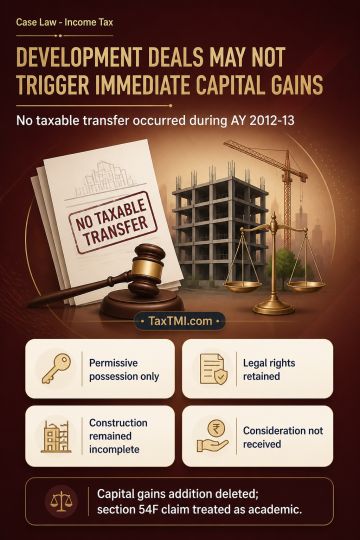
Development agreements require legal possession or effective enjoyment for capital gains transfer; permissive possession and deferred consideration de...
Prolonged sterilisation of development rights supports capital-gains treatment, while business-income disallowances cannot govern capital-gains comput...
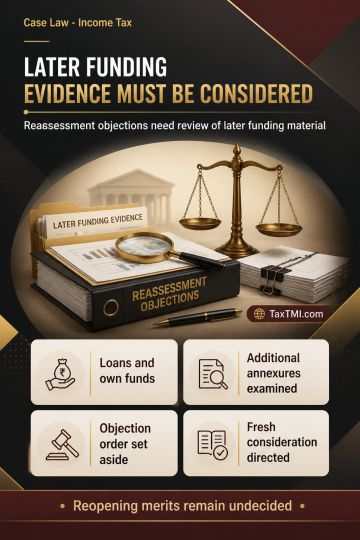
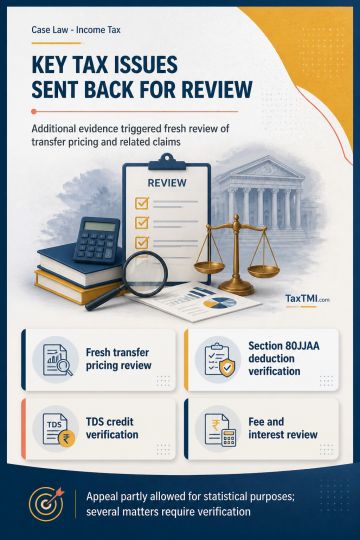
Additional evidence in transfer pricing dispute leads to fresh examination, while tax deductions, TDS credit, fee and refund interest require verifica...
Category II AIF pass-through taxation preserves non-business income character; investment receipts cannot be reclassified without applying recognised ...
HC held that when excess stock is discovered during a survey under GST Act section 67, proceedings must be initiated under sections 73/74, not section 130. The statutory framework mandates that if a registered dealer fails to account for goods, the Proper Officer shall determine tax liability through sections 73/74. The court emphasized that GST Act is a comprehensive code, and section 130 cannot be invoked when specific provisions exist for addressing undeclared stock. The petitioner's challenge to proceedings was consequently allowed, establishing a clear legal principle that excess stock discovery triggers assessment proceedings rather than punitive actions.
HC held that when excess stock is discovered during a survey under GST Act section 67, proceedings must be initiated under sections 73/74, not section 130. The statutory framework mandates that if a registered dealer fails to account for goods, the Proper Officer shall determine tax liability through sections 73/74. The court emphasized that GST Act is a comprehensive code, and section 130 cannot be invoked when specific provisions exist for addressing undeclared stock. The petitioner's challenge to proceedings was consequently allowed, establishing a clear legal principle that excess stock discovery triggers assessment proceedings rather than punitive actions.
Note: It is a system-generated summary and is for quick reference only.
 TaxTMI
  TaxTMI
 of 4807









 Join Channel


