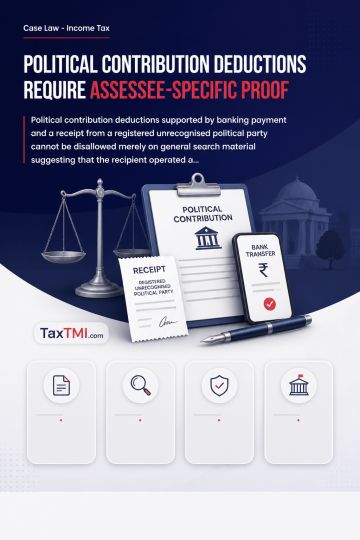
Political contribution deductions require assessee-specific proof before cash-back allegations can justify disallowance or unexplained-money additions...
SC held that the HC's exercise of supervisory jurisdiction under Article 227 was improper. The power is fundamentally supervisory and must be sparingly invoked only in cases of apparent jurisdictional errors or grave injustice. By rejecting the plaint prematurely, the HC effectively usurped the trial court's original jurisdiction and negated the appellant's statutory right of appeal. The court emphasized that procedural safeguards are critical to the rule of law, and short-circuiting established legal procedures undermines judicial consistency. The HC's order was set aside, restoring the standard adjudicatory process and preserving procedural integrity.
SC held that the HC's exercise of supervisory jurisdiction under Article 227 was improper. The power is fundamentally supervisory and must be sparingly invoked only in cases of apparent jurisdictional errors or grave injustice. By rejecting the plaint prematurely, the HC effectively usurped the trial court's original jurisdiction and negated the appellant's statutory right of appeal. The court emphasized that procedural safeguards are critical to the rule of law, and short-circuiting established legal procedures undermines judicial consistency. The HC's order was set aside, restoring the standard adjudicatory process and preserving procedural integrity.
Note: It is a system-generated summary and is for quick reference only.
 TaxTMI
  TaxTMI
















 Join Channel


