Loading...

Top
Help
×

By creating an account you can:

Logo TaxTMI
Call Us / Help / Feedback

Contact Us At :

E-mail: [email protected]

Call / WhatsApp at: +91 99117 96707

For more information, Check Contact Us

FAQs :

To know Frequently Asked Questions, Check FAQs

Most Asked Video Tutorials :

For more tutorials, Check Video Tutorials

Submit Feedback/Suggestion :

Email :
Please provide your email address so we can follow up on your feedback.
Category :
Description :
Min 15 characters 0/2000
Make Most of Text Search
  1. Checkout this video tutorial: How to search effectively on TaxTMI.
  2. Put words in double quotes for exact word search, eg: "income tax"
  3. Avoid noise words such as : 'and, of, the, a'
  4. Sort by Relevance to get the most relevant document.
  5. Press Enter to add multiple terms/multiple phrases, and then click on Search to Search.
  6. Text Search
  7. The system will try to fetch results that contains ALL your words.
  8. Once you add keywords, you'll see a new 'Search In' filter that makes your results even more precise.
  9. Text Search
Add to...
You have not created any category. Kindly create one to bookmark this item!
Create New Category
Hide
Title :
Description :
❮❮ Hide
Default View
Expand ❯❯
Close ✕
🔎 Highlights - Adv. Search
TEXT SEARCH:

Press 'Enter' to add multiple search terms. Rules for Better Search

Search In:
Main Text + AI Text
  • Main Text
  • Main Text + AI Text
  • AI Text
Law:
---- All Laws----
  • ---- All Laws----
  • Income Tax
  • Direct Taxes
  • Benami Property
  • Central GST Laws
  • SGST - State GST Laws
  • Customs
  • FTP - Foreign Trade Policy
  • SEZ - Special Economic Zone
  • FEMA - Foreign Exchange Management
  • Companies Law
  • SEBI - Securities & Exchange Board of India
  • IBC - Insolvency and Bankruptcy
  • Law of Competition
  • PMLA - Money-Laundering
  • Indian Laws
  • Bill / Finance Bills
  • Wealth Tax
  • Service Tax
  • Central Excise
  • VAT / Sales Tax
Month:
---- All Months ----
  • ---- All Months ----
  • January
  • February
  • March
  • April
  • May
  • June
  • July
  • August
  • September
  • October
  • November
  • December
Year:
---- All Years ----
  • ---- All Years ----
  • 2026
  • 2025
  • 2024
  • 2023
  • 2022
  • 2021
  • 2020
  • 2019
  • 2018
  • 2017
  • 2016
  • 2015
  • 2014
  • 2013
  • 2012
  • 2011
Sort By: ?
In Sort By 'Default', exact matches for text search are shown at the top, followed by the remaining results in their regular order.
Relevance Default Date
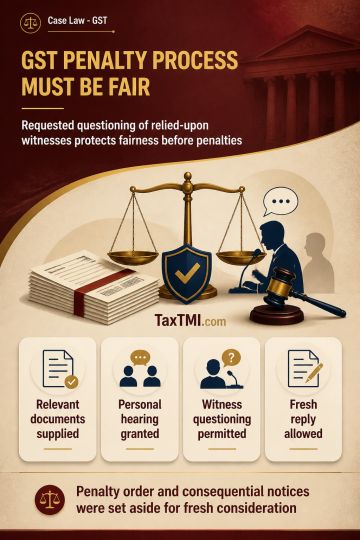
    Cross-examination in GST penalty proceedings protects natural justice where witness statements support the proposed penalty.
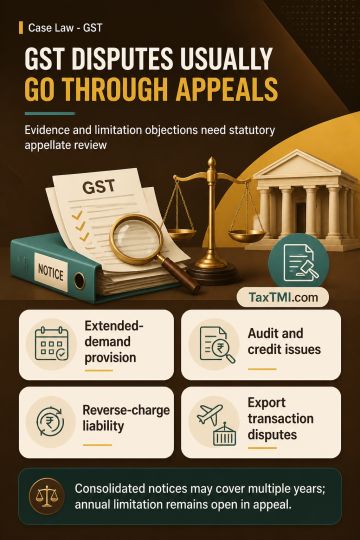
    Alternative statutory remedy governs GST adjudication challenges where evidence and limitation objections require appellate review.
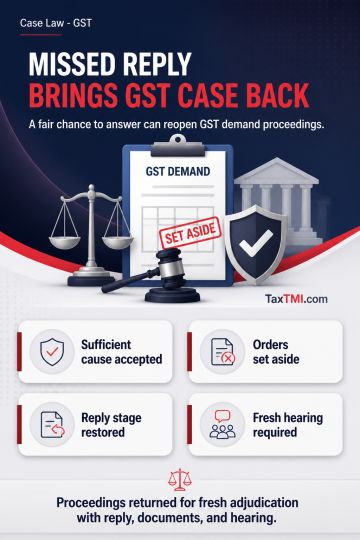
    Opportunity to answer a GST show-cause notice required restoration of demand proceedings for fresh adjudication.
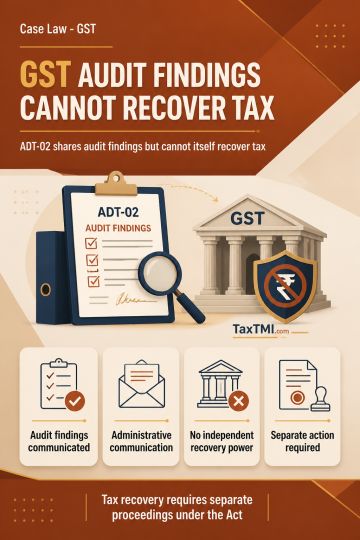
    GST audit findings in Form GST ADT-02 communicate observations but cannot independently authorise tax recovery proceedings.
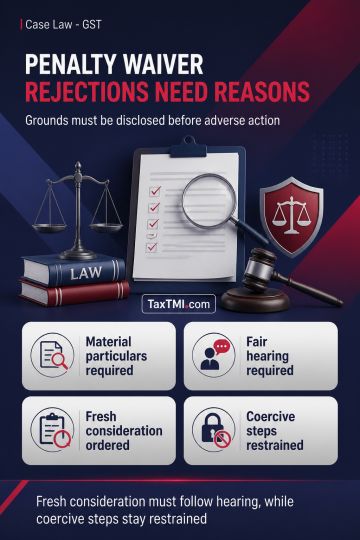
    Reasoned Decisions in Kara Samadhana applications require disclosed grounds and a hearing before adverse action.
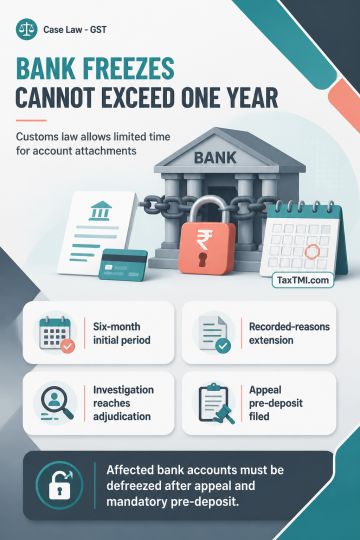
    Statutory limits on customs bank-account attachments bar continued debit freezes after investigation, adjudication, and expiry of permitted duration.
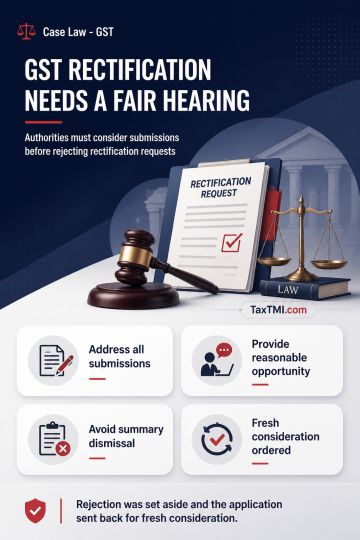
    Natural justice in GST rectification requires consideration of submissions and reasonable hearing before rejection and fresh determination.
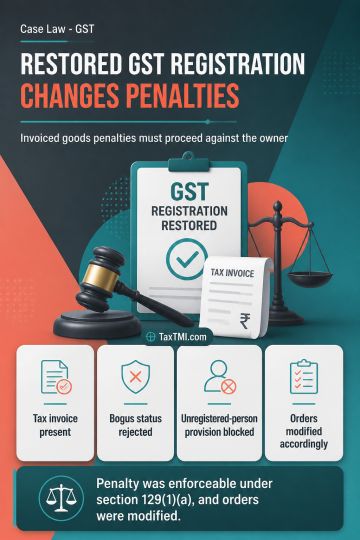
    GST detention penalties for invoiced goods must proceed against the owner, not under unregistered-person provisions after registration restoration.
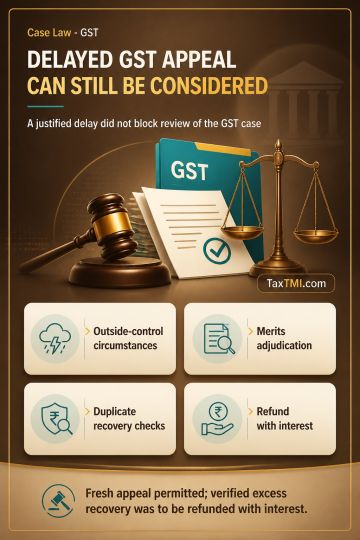
    GST appellate delay: lack of control justified condonation and merits review, while alleged duplicate recovery required verification and refund.
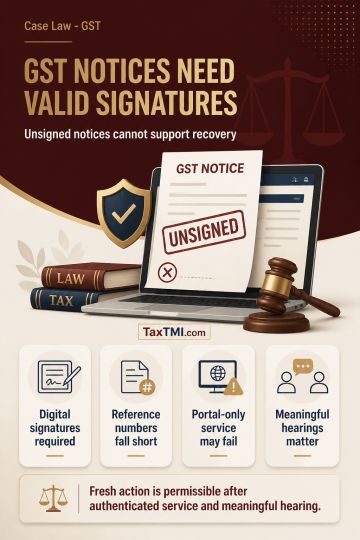
    Authentication of electronic GST notices is mandatory; unsigned portal documents cannot sustain adjudication or recovery without effective hearing.
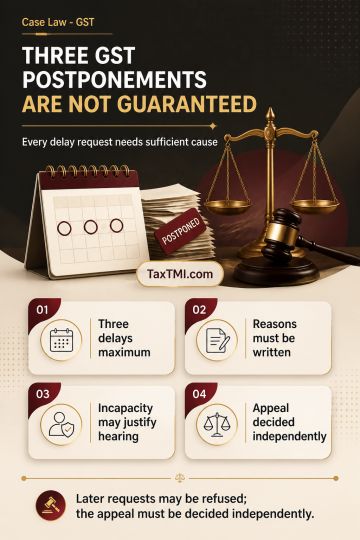
    GST appellate adjournments require sufficient cause; the three-adjournment limit is a ceiling, not an automatic litigant entitlement.
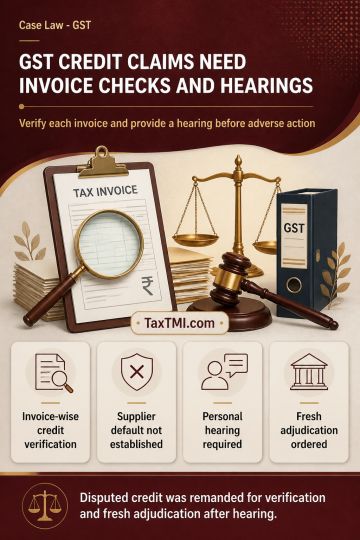
    GSTR-2A mismatches require invoice-wise credit verification, while adverse GST adjudication requires a mandatory personal hearing.
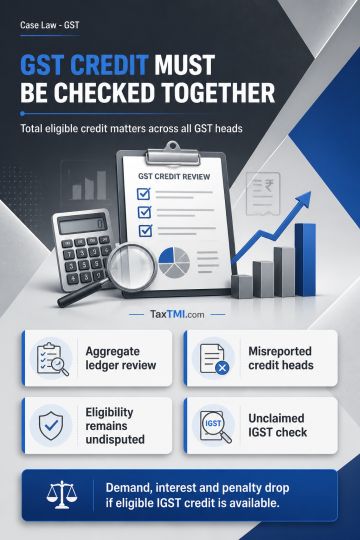
    Input tax credit misclassification across GST heads requires aggregate ledger verification before any excess-credit demand can stand.
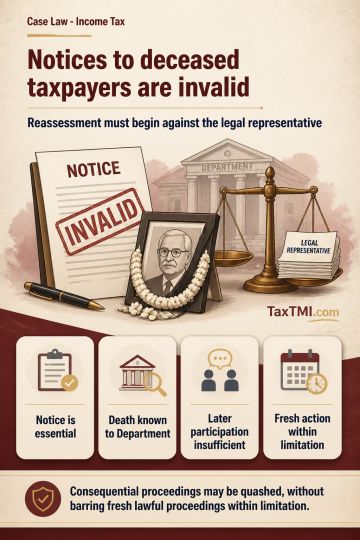
    Reassessment Notices Issued to Deceased Assessees Are Jurisdictionally Invalid and Require Proceedings Against Legal Representatives
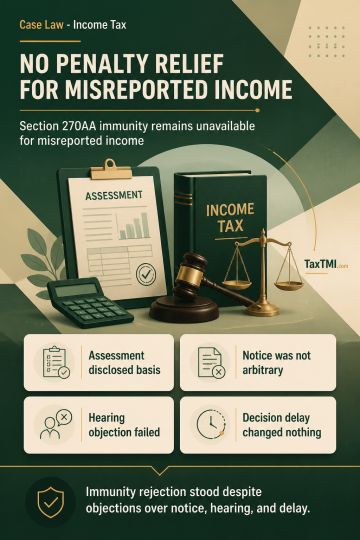
    Penalty immunity for misreported income remains unavailable despite objections to notice, hearing, and decision delay.
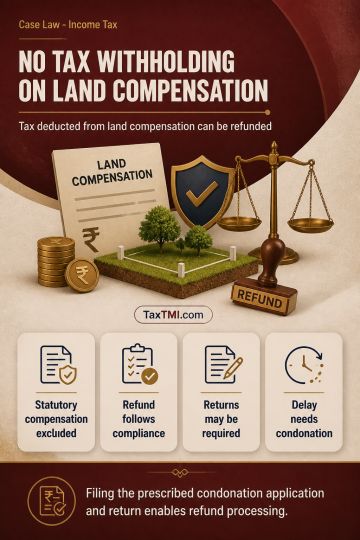
    Land-acquisition compensation remains outside income-tax withholding, enabling refund of tax deducted after prescribed compliance is completed.
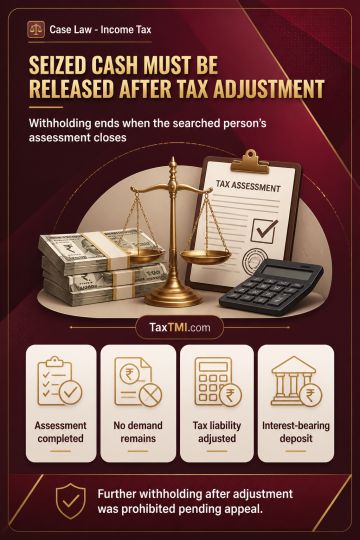
    Retention of seized cash ends when the searched person's assessment closes, requiring release after tax adjustment.
    Leave-encashment exemption under the enhanced limit may be pursued through revised returns, with eligibility questions left open.
    Genuine charitable activities require a trust's own educational work, not merely rental income from leased school premises.
    Best judgment assessment requires rational, business-specific profit estimation; online share-trading addition was deleted for unsupported guesswork.
❯❯
Maximize Maximize Maximize
0 / 200
Expand Note
Add to Folder

No Folders have been created

+

Are you sure you want to delete "My most important" ?

NOTE:

Highlights
Showing Results for :
Reset Filters
Results Found:
Show All Summaries Hide All Summaries

Highlights

Back

All Highlights

Showing Results for :
Reset Filters
No Records Found

Highlights

Back

All Highlights

whatsapp Join Channel
Showing Results for : Reset Filters
Central Excise

CESTAT adjudicated a central excise duty dispute involving...

Tribunal Finds No Duty Evasion in Related Party Transaction, Validates Valuation Methodology and Dismisses Revenue Claim

Contents
Summary
Note

Note

-

Bookmark

Print

Print

Central Excise April 29, 2025 Case Laws AT
CESTAT adjudicated a central excise duty dispute involving alleged undervaluation of finished products sold to a related unit. The tribunal examined prior proceedings and found no substantive evidence supporting claims of intentional duty evasion. Critically, the tribunal determined the appellant's value addition and duty payments were legitimate and consistent. The tribunal concluded that the revenue demand was unsupported, effectively rendering the allegations baseless. Given the revenue-neutral nature of the transactions and precedent established in the appellant's previous case, the tribunal allowed the appeal, setting aside the original duty demand and affirming the appellant's valuation methodology.

Topics

Acts Income Tax