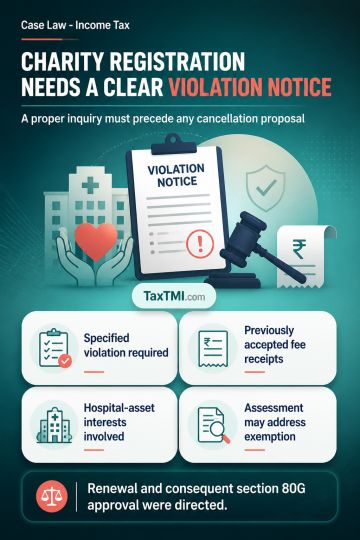
Charitable trust registration requires a specified-violation notice; settled cash deposits and related-party payments did not justify cancellation or ...
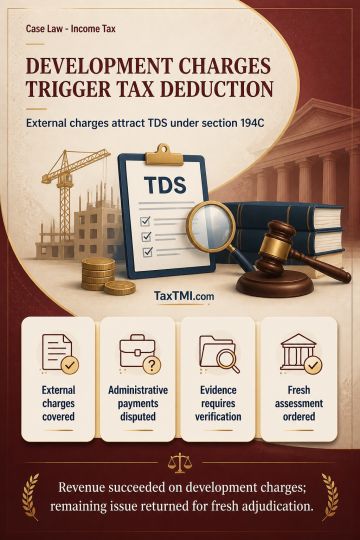
External development charges trigger TDS under section 194C, while disputed administrative payments require factual verification and fresh adjudicatio...
Section 270AA penalty immunity requires identified statutory defaults and a hearing before rejection; reassessment disclosure may constitute under-rep...
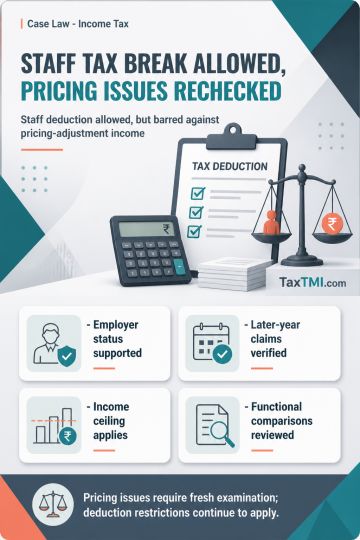
Section 80JJAA employee-cost deduction allowed for deployed staff but barred against transfer-pricing income enhancement, with pricing issues remanded...
Transfer-pricing methodology protects commercially genuine associated-enterprise payments, while pre-2016 secondary adjustments and related notional i...
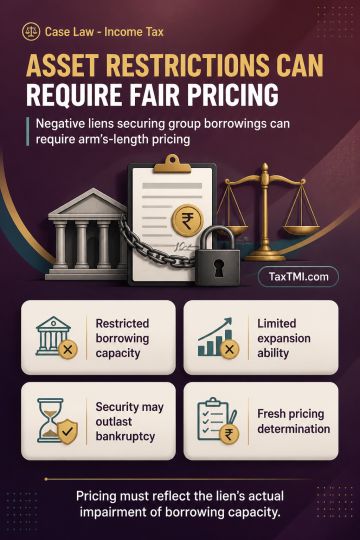
Negative liens over operating assets can constitute international transactions requiring arm's-length pricing reflecting restricted borrowing and expa...
Cross-examination rights in Customs Broker revocation inquiries require witness examination; procedural denial may be cured through fresh adjudication...
The CBIC issued Circular No. 15/2025-Customs to simplify air cargo movement and transhipment procedures. Key modifications include eliminating the Rs. 20 transshipment permit fee and harmonizing Unit Load Device (ULD) movement regulations. Carriers can now temporarily import ULDs outside customs areas by executing a "Continuity Bond" with specific requirements for tracking devices. The circular aims to enhance trade facilitation, reduce compliance burdens, and streamline customs protocols for air cargo transportation. Tracking devices must comply with aviation security guidelines, and carriers bear responsibility for proving ULD export within specified timeframes. The directive supports the government's objective of improving infrastructure and making customs processes more user-friendly.
The CBIC issued Circular No. 15/2025-Customs to simplify air cargo movement and transhipment procedures. Key modifications include eliminating the Rs. 20 transshipment permit fee and harmonizing Unit Load Device (ULD) movement regulations. Carriers can now temporarily import ULDs outside customs areas by executing a "Continuity Bond" with specific requirements for tracking devices. The circular aims to enhance trade facilitation, reduce compliance burdens, and streamline customs protocols for air cargo transportation. Tracking devices must comply with aviation security guidelines, and carriers bear responsibility for proving ULD export within specified timeframes. The directive supports the government's objective of improving infrastructure and making customs processes more user-friendly.
Note: It is a system-generated summary and is for quick reference only.
 TaxTMI
  TaxTMI
 of 4828

















 Join Channel


