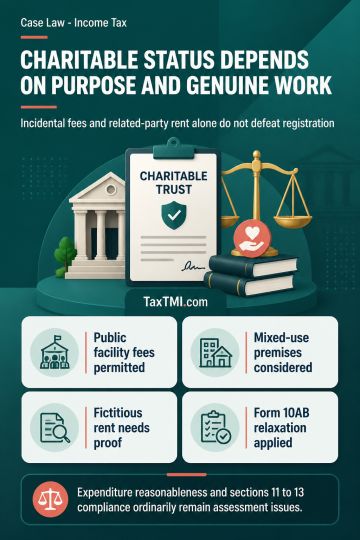
Charitable registration turns on predominant purpose and genuine activities, while incidental fees and related-party rent require supporting adverse m...
MAT book-profit adjustments exclude disallowances for exempt-income expenditure and demerger expenditure unless expressly listed under the statutory c...
ITAT adjudicated a tax dispute involving consultancy income from...
Non-resident entity's tax dispute resolved through careful treaty interpretation of India-UAE DTAA, balancing income classification and PE considerations
Contents
Summary
Note
Bookmark
Share
✓ Copied successfully !
Print
Print Options
For full text, please login
Login to TaxTMI
Verification Pending
The Email Id has not been verified. Click on the link we have sent on
ITAT adjudicated a tax dispute involving consultancy income from a non-resident entity without permanent establishment (PE) in India. The tribunal examined treaty benefits under India-UAE Double Taxation Avoidance Agreement (DTAA), specifically Articles 7 and 22. Despite presenting a valid Tax Residency Certificate (TRC) for 2018 and earning marketing commission, the tribunal determined that Article 7 was inapplicable due to absence of PE. Consequently, the tribunal ruled the assessee eligible for benefits under Article 22 and directed the Assessing Officer (AO) to recompute the tax liability, effectively providing partial relief to the non-resident taxpayer by recognizing treaty protection mechanisms.
ITAT adjudicated a tax dispute involving consultancy income from a non-resident entity without permanent establishment (PE) in India. The tribunal examined treaty benefits under India-UAE Double Taxation Avoidance Agreement (DTAA), specifically Articles 7 and 22. Despite presenting a valid Tax Residency Certificate (TRC) for 2018 and earning marketing commission, the tribunal determined that Article 7 was inapplicable due to absence of PE. Consequently, the tribunal ruled the assessee eligible for benefits under Article 22 and directed the Assessing Officer (AO) to recompute the tax liability, effectively providing partial relief to the non-resident taxpayer by recognizing treaty protection mechanisms.
Note: It is a system-generated summary and is for quick reference only.
 TaxTMI







 Join Channel


 TaxTMI

