Cross-examination rights and corroborated evidence limit customs penalties for misdeclaration in genuine import transactions involving documented clea...
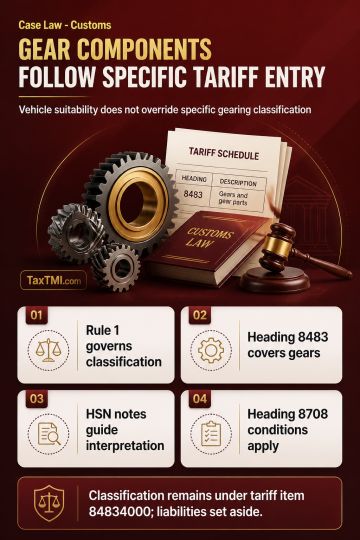
Tariff classification of vehicle gear components follows the specific gearing entry, displacing motor-vehicle parts classification and related liabili...
Necessary-party requirements limit impleadment of independent entities, while deferred consideration does not create an appealable adverse determinati...
Food supplement classification requires common parlance and authoritative tests, preventing treatment as proprietary Ayurvedic medicines without suppo...
Specified regulatory authority income receives conditional tax exemption, subject to non-commercial activity, unchanged income character, and return f...
Tax exemption for regulatory authority income applies retrospectively, subject to non-commercial activity, unchanged income sources, and return-filing...
The ITAT examined multiple aspects of a tax penalty case involving undisclosed income. The tribunal found no justification for penalty u/s 271(1)(c) across various income categories including house property, buffer income, and salary. Key determinations included: (1) the complexity of tax law precluded deliberate concealment, (2) residential status dispute undermined penalty proceedings, and (3) penalty orders were time-barred under section 275(1)(c). Critically, the immunity period granted by the Settlement Commission and subsequent legal challenges rendered the penalty unsustainable. The tribunal ultimately upheld the CIT(A)'s order quashing the penalty, dismissing revenue's grounds and finding the penalty proceedings statutorily invalid due to limitation constraints.
The ITAT examined multiple aspects of a tax penalty case involving undisclosed income. The tribunal found no justification for penalty u/s 271(1)(c) across various income categories including house property, buffer income, and salary. Key determinations included: (1) the complexity of tax law precluded deliberate concealment, (2) residential status dispute undermined penalty proceedings, and (3) penalty orders were time-barred under section 275(1)(c). Critically, the immunity period granted by the Settlement Commission and subsequent legal challenges rendered the penalty unsustainable. The tribunal ultimately upheld the CIT(A)'s order quashing the penalty, dismissing revenue's grounds and finding the penalty proceedings statutorily invalid due to limitation constraints.
Note: It is a system-generated summary and is for quick reference only.
 TaxTMI
 of 4798



















 Join Channel


 TaxTMI

