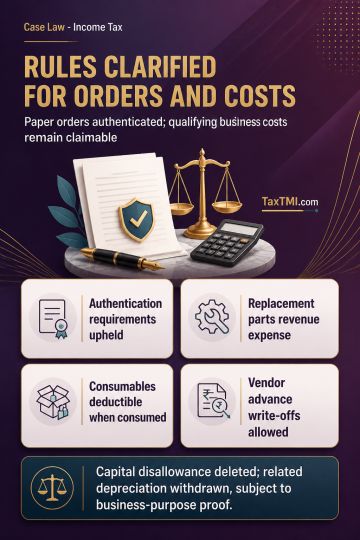
Authentication of paper assessment orders upheld, while qualifying repairs, consumables and vendor advance write-offs remain deductible business claim...
Transaction value cannot be rejected solely on non-statutory valuation guidelines without corroborative evidence supporting reassessment of final cust...
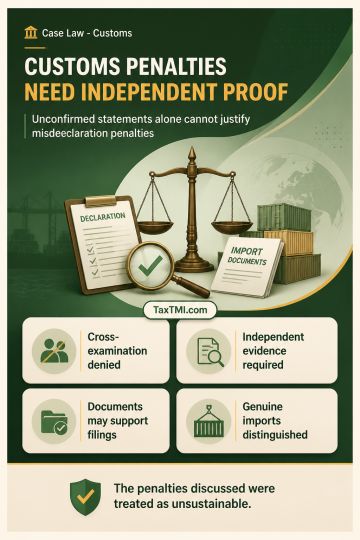
Cross-examination rights and corroborated evidence limit customs penalties for misdeclaration in genuine import transactions involving documented clea...
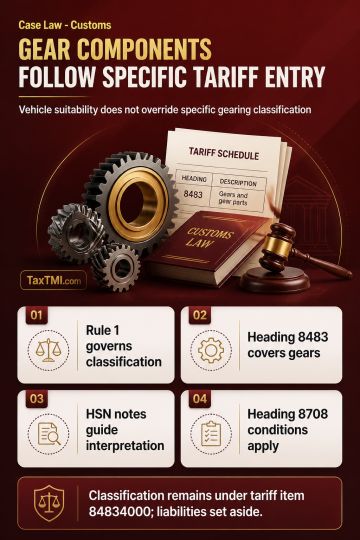
Tariff classification of vehicle gear components follows the specific gearing entry, displacing motor-vehicle parts classification and related liabili...
HC held that service of notice/order via common portal is valid...
Electronic Service via Common Portal Legally Valid Under GST Act, Section 169(1)(d) Enables Direct Digital Notification Without Additional Requirements
Contents
Summary
Note
Bookmark
Share
✓ Copied successfully !
Print
Print Options
For full text, please login
Login to TaxTMI
Verification Pending
The Email Id has not been verified. Click on the link we have sent on
HC held that service of notice/order via common portal is valid under GST Act. Section 169(1)(d) independently provides for electronic service through common portal, without requiring additional notification under Section 146. The statutory provision explicitly enables serving decisions, orders, summons, and notices electronically. The petitioner's contention challenging portal-based service was rejected. The court set aside impugned orders, directing petitioner to deposit 25% of disputed taxes within four weeks. The judgment affirms the legal validity of electronic service mechanisms in GST proceedings.
HC held that service of notice/order via common portal is valid under GST Act. Section 169(1)(d) independently provides for electronic service through common portal, without requiring additional notification under Section 146. The statutory provision explicitly enables serving decisions, orders, summons, and notices electronically. The petitioner's contention challenging portal-based service was rejected. The court set aside impugned orders, directing petitioner to deposit 25% of disputed taxes within four weeks. The judgment affirms the legal validity of electronic service mechanisms in GST proceedings.
Note: It is a system-generated summary and is for quick reference only.
 TaxTMI
 of 4805












 Join Channel


 TaxTMI