Tax deduction compliance and payee income recognition govern consultancy disallowance, while no exempt income prevents related expenditure disallowanc...
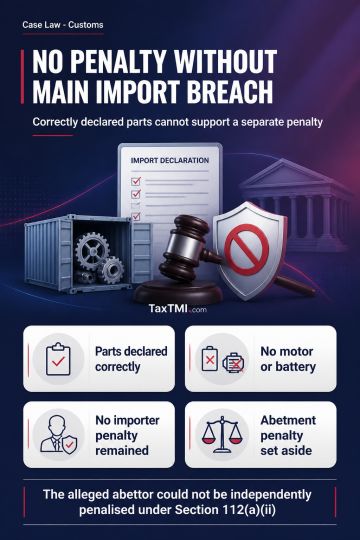
Derivative abetment liability fails when correctly declared imported components establish no underlying improper importation by the principal importer...
The ITAT rejected the assessee's books of accounts as unreliable and estimated business profits at 2.21% instead of the 0.47% originally returned. The Tribunal upheld the CIT(A)'s decision based on identical circumstances found in a sister concern's case. The Tribunal rejected the Revenue's argument for a higher profit rate and found the proposed comparable entity to be in a different business line. The Tribunal clarified that the estimated income should subsume previous disallowances to prevent double taxation, ensuring the total income computation matches the 2.21% of turnover estimation. Consequently, the Tribunal upheld the CIT(A)'s order, rejecting separate additions for unaccounted sales and unexplained expenditure as these were already incorporated in the profit estimation.
The ITAT rejected the assessee's books of accounts as unreliable and estimated business profits at 2.21% instead of the 0.47% originally returned. The Tribunal upheld the CIT(A)'s decision based on identical circumstances found in a sister concern's case. The Tribunal rejected the Revenue's argument for a higher profit rate and found the proposed comparable entity to be in a different business line. The Tribunal clarified that the estimated income should subsume previous disallowances to prevent double taxation, ensuring the total income computation matches the 2.21% of turnover estimation. Consequently, the Tribunal upheld the CIT(A)'s order, rejecting separate additions for unaccounted sales and unexplained expenditure as these were already incorporated in the profit estimation.
Note: It is a system-generated summary and is for quick reference only.
 TaxTMI
 of 4792
















 Join Channel


 TaxTMI
