GST refunds for cancelled air tickets remain available when passenger reimbursements defeat unjust enrichment and credit-note adjustment is unavailabl...
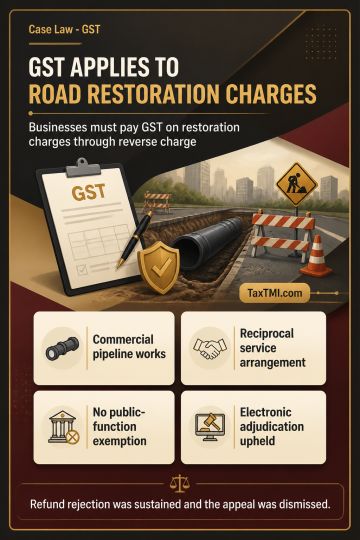
Request-driven road restoration attracts reverse-charge GST, not governmental-function treatment or compensatory-damages status for business recipient...
Road restoration charges for commercial pipeline works are taxable Government services, with reverse charge liability and no public-function exemption...
ITAT held that the revision proceedings under Section 263 were invalid. The PCIT failed to establish both essential conditions: the AO's order being erroneous and prejudicial to revenue interests. The tribunal emphasized that Section 263 cannot be invoked to correct every minor error or merely to generate additional tax revenue. The notice issued under Section 263 was deemed void ab initio, as the proceedings fell outside the scope of recorded reasons. Consequently, the order passed under Section 263 was declared legally unsound, and the assessee's appeal was allowed, effectively nullifying the revisional proceedings.
ITAT held that the revision proceedings under Section 263 were invalid. The PCIT failed to establish both essential conditions: the AO's order being erroneous and prejudicial to revenue interests. The tribunal emphasized that Section 263 cannot be invoked to correct every minor error or merely to generate additional tax revenue. The notice issued under Section 263 was deemed void ab initio, as the proceedings fell outside the scope of recorded reasons. Consequently, the order passed under Section 263 was declared legally unsound, and the assessee's appeal was allowed, effectively nullifying the revisional proceedings.
Note: It is a system-generated summary and is for quick reference only.
 TaxTMI
  TaxTMI
 of 4920