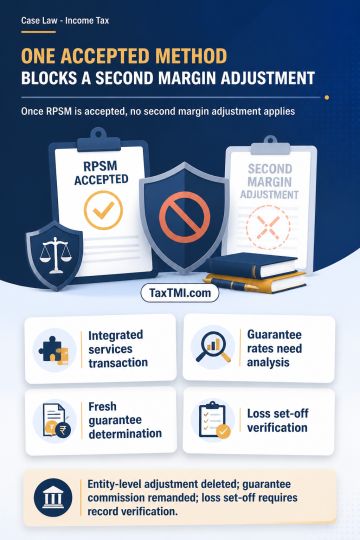
Form 26AS evidence requires successor-entity accounting verification after business transfer, while invoice-supported related-party advertising expend...
Money-laundering judgment timing requires awaiting the scheduled-offence decision despite continuation of the underlying trial where outcomes directly...
Accredited investor eligibility expands through securities-market exposure, while alternative investment fund disputes require prescribed resolution a...
Page of 4916
Press 'Enter' after typing page number.
41 to 60 of 98302 Results
❮
❯
❯❯
0 / 200
Expand Note
Add to Folder
No Folders have been created
+
Are you sure you want to delete "My most important" ?
ITAT allowed the assessee's appeal challenging leave encashment deduction under section 10(10AA). The tribunal found that the CIT(A)'s rejection based on non-submission of Form 16 was untenable, as the Assessing Officer already had information about the claimed amount of Rs. 20,29,482. Pursuant to the CBDT notification dated 24th May 2023, the leave encashment limit was revised to Rs. 25,00,000, thereby enabling the assessee to claim the entire amount instead of the previously restricted Rs. 3,00,000. The tribunal directed the Assessing Officer to allow the deduction consistent with the revised statutory limit.
ITAT allowed the assessee's appeal challenging leave encashment deduction under section 10(10AA). The tribunal found that the CIT(A)'s rejection based on non-submission of Form 16 was untenable, as the Assessing Officer already had information about the claimed amount of Rs. 20,29,482. Pursuant to the CBDT notification dated 24th May 2023, the leave encashment limit was revised to Rs. 25,00,000, thereby enabling the assessee to claim the entire amount instead of the previously restricted Rs. 3,00,000. The tribunal directed the Assessing Officer to allow the deduction consistent with the revised statutory limit.
Note: It is a system-generated summary and is for quick reference only.
 TaxTMI
 TaxTMI

 of 4916