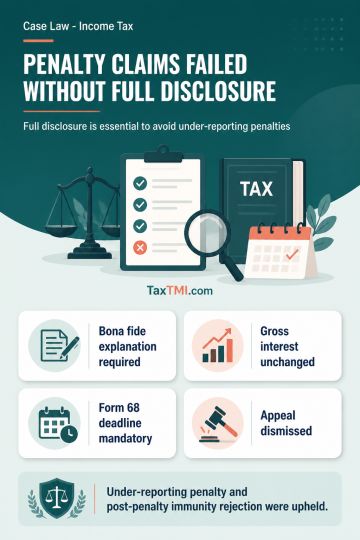
Bona fide disclosure requirements govern under-reporting penalties, and post-penalty immunity applications cannot secure available statutory protectio...
Certificate-of-origin verification procedure governs preferential customs benefits; denial without retroactive verification was set aside with consequ...
Disciplinary Committee jurisdiction and mandatory investigation requirements invalidated cancellation of an insolvency professional's registration and...
HC held that the 60-day period under Section 62(2) of GST Act is directory, not mandatory. The petitioner failed to file returns for October 2018 to March 2019 within prescribed time limit, resulting in a best judgment assessment order. The court determined that if an assessee demonstrates valid reasons beyond their control for delay, they can file returns after paying applicable interest and penalties. The petitioner was directed to submit an application for condonation of delay within 15 days, with the understanding that the tax authority shall consider such application on its merits, preserving the fundamental right to file returns.
HC held that the 60-day period under Section 62(2) of GST Act is directory, not mandatory. The petitioner failed to file returns for October 2018 to March 2019 within prescribed time limit, resulting in a best judgment assessment order. The court determined that if an assessee demonstrates valid reasons beyond their control for delay, they can file returns after paying applicable interest and penalties. The petitioner was directed to submit an application for condonation of delay within 15 days, with the understanding that the tax authority shall consider such application on its merits, preserving the fundamental right to file returns.
Note: It is a system-generated summary and is for quick reference only.
 TaxTMI
 of 4805
















 Join Channel


 TaxTMI
