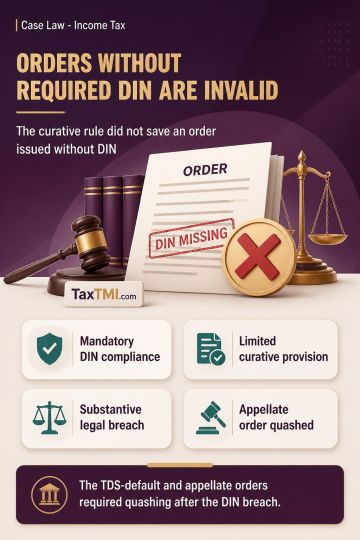
Document Identification Number compliance renders TDS-default orders invalid where mandatory DIN requirements are breached and curative provision does...
ITAT determined that for benchmarking outstanding receivables from Associated Enterprises (AEs), the applicable interest rate should be LIBOR, not domestic prime lending rates. The tribunal found the average LIBOR rate for 1-4-2005 to 31-3-2006 was 4.42%, and since the assessee charged 6% interest, which exceeded LIBOR, no additional transfer pricing adjustment was warranted. The decision emphasized that international transactions with AEs must be evaluated using international benchmark rates like LIBOR or EURIBOR, rather than domestic lending rates, ensuring arm's length pricing principles are consistently applied in cross-border financial transactions.
ITAT determined that for benchmarking outstanding receivables from Associated Enterprises (AEs), the applicable interest rate should be LIBOR, not domestic prime lending rates. The tribunal found the average LIBOR rate for 1-4-2005 to 31-3-2006 was 4.42%, and since the assessee charged 6% interest, which exceeded LIBOR, no additional transfer pricing adjustment was warranted. The decision emphasized that international transactions with AEs must be evaluated using international benchmark rates like LIBOR or EURIBOR, rather than domestic lending rates, ensuring arm's length pricing principles are consistently applied in cross-border financial transactions.
Note: It is a system-generated summary and is for quick reference only.
 TaxTMI
  TaxTMI
 of 4918