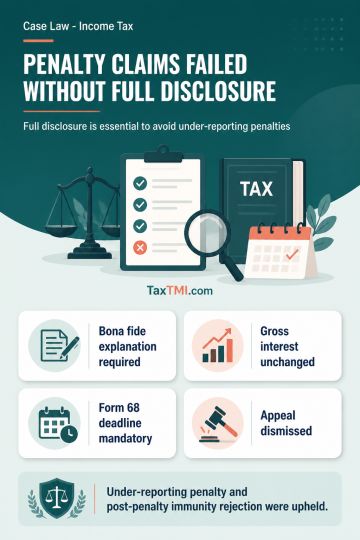
Bona fide disclosure requirements govern under-reporting penalties, and post-penalty immunity applications cannot secure available statutory protectio...
Certificate-of-origin verification procedure governs preferential customs benefits; denial without retroactive verification was set aside with consequ...
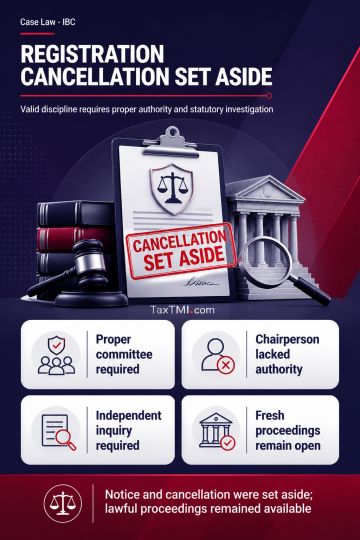
Disciplinary Committee jurisdiction and mandatory investigation requirements invalidated cancellation of an insolvency professional's registration and...
The AAR ruled that the applicant cannot avail Input Tax Credit (ITC) on inputs and services used for constructing a concrete tower to support VCV lines for manufacturing EHV cables. Applying the Supreme Court's functionality test from Safari Retreats, the AAR determined that while a building may qualify as "plant" under Section 17(5)(d) of CGST Act, ITC is unavailable when construction is for the recipient's own use. The AAR found the applicant failed to prove the construction was not on their own account, breaking the ITC chain. The authority dismissed the applicant's reliance on various judgments as irrelevant, noting they primarily pertained to Income Tax matters rather than GST provisions.
The AAR ruled that the applicant cannot avail Input Tax Credit (ITC) on inputs and services used for constructing a concrete tower to support VCV lines for manufacturing EHV cables. Applying the Supreme Court's functionality test from Safari Retreats, the AAR determined that while a building may qualify as "plant" under Section 17(5)(d) of CGST Act, ITC is unavailable when construction is for the recipient's own use. The AAR found the applicant failed to prove the construction was not on their own account, breaking the ITC chain. The authority dismissed the applicant's reliance on various judgments as irrelevant, noting they primarily pertained to Income Tax matters rather than GST provisions.
Note: It is a system-generated summary and is for quick reference only.
 TaxTMI
 of 4805









 Join Channel


 TaxTMI
