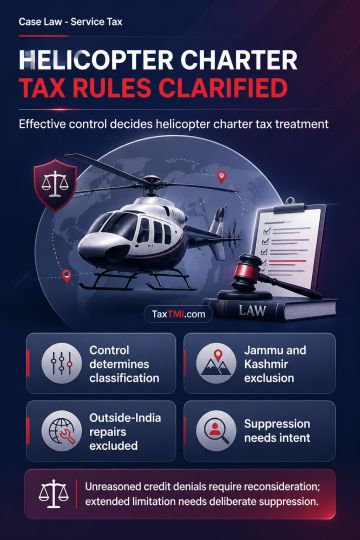
Helicopter charter classification requires effective control analysis, while territorial performance, reasoned credit orders and wilful suppression de...
Specified fund definition expands PAN exemption eligibility for registered alternative investment funds and qualifying International Financial Service...
Tax exemption for specified legal-services authority income applies retrospectively, subject to non-commercial activity, unchanged income sources, and...
Approved resolution plans extinguish unsubmitted pre-approval tax claims, preventing later recovery outside the insolvency process and preserving a cl...
The HC quashed non-bailable warrants issued against the petitioner accused of GST evasion through fake firms. The court held that non-bailable warrants should only be issued when an accused fails to appear after service of summons or bailable warrants. In this case, the petitioner had previously cooperated with the investigation, appeared before authorities, and provided statements. The court converted the non-bailable warrants to bailable warrants, noting that the petitioner showed no likelihood of evading legal process. Applying the principle from Tarsem Lal and Sharif Ahmed precedents, the HC emphasized that courts must consider whether an accused is likely to evade justice or tamper with evidence before issuing non-bailable warrants. The presumption of innocence was also affirmed as a fundamental principle of criminal jurisprudence.
The HC quashed non-bailable warrants issued against the petitioner accused of GST evasion through fake firms. The court held that non-bailable warrants should only be issued when an accused fails to appear after service of summons or bailable warrants. In this case, the petitioner had previously cooperated with the investigation, appeared before authorities, and provided statements. The court converted the non-bailable warrants to bailable warrants, noting that the petitioner showed no likelihood of evading legal process. Applying the principle from Tarsem Lal and Sharif Ahmed precedents, the HC emphasized that courts must consider whether an accused is likely to evade justice or tamper with evidence before issuing non-bailable warrants. The presumption of innocence was also affirmed as a fundamental principle of criminal jurisprudence.
Note: It is a system-generated summary and is for quick reference only.
 TaxTMI
 of 4805





















 Join Channel


 TaxTMI
