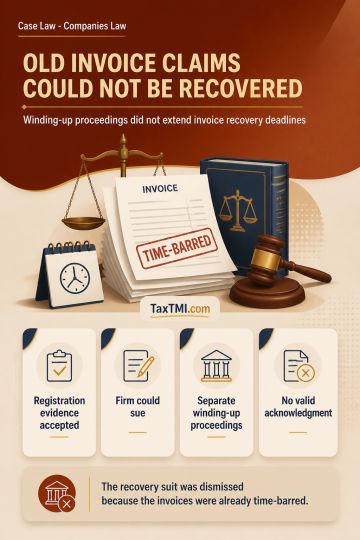
Invoice-based recovery claims remain time-barred despite separate winding-up proceedings, absent valid acknowledgment or part-payment of the disputed ...
Extended limitation fails without specific suppression allegations, while overseas employee secondment remains taxable as manpower supply within norma...
Time-share accommodation classification excludes Club or Association Service where purchasers receive contractual occupancy rights without genuine mem...
CENVAT credit for trading requires reversal, while taxable-service rental credit remains proportionately available and limitation issues await resolut...
Vicarious liability for dishonoured company cheques may extend to non-signatory directors where complaints contain foundational responsibility avermen...
The HC quashed non-bailable warrants issued against the petitioner accused of GST evasion through fake firms. The court held that non-bailable warrants should only be issued when an accused fails to appear after service of summons or bailable warrants. In this case, the petitioner had previously cooperated with the investigation, appeared before authorities, and provided statements. The court converted the non-bailable warrants to bailable warrants, noting that the petitioner showed no likelihood of evading legal process. Applying the principle from Tarsem Lal and Sharif Ahmed precedents, the HC emphasized that courts must consider whether an accused is likely to evade justice or tamper with evidence before issuing non-bailable warrants. The presumption of innocence was also affirmed as a fundamental principle of criminal jurisprudence.
The HC quashed non-bailable warrants issued against the petitioner accused of GST evasion through fake firms. The court held that non-bailable warrants should only be issued when an accused fails to appear after service of summons or bailable warrants. In this case, the petitioner had previously cooperated with the investigation, appeared before authorities, and provided statements. The court converted the non-bailable warrants to bailable warrants, noting that the petitioner showed no likelihood of evading legal process. Applying the principle from Tarsem Lal and Sharif Ahmed precedents, the HC emphasized that courts must consider whether an accused is likely to evade justice or tamper with evidence before issuing non-bailable warrants. The presumption of innocence was also affirmed as a fundamental principle of criminal jurisprudence.
Note: It is a system-generated summary and is for quick reference only.
 TaxTMI
 of 4803

















 Join Channel


 TaxTMI