Service of notice and contractual debt acknowledgment preserved insolvency admission against a corporate guarantor despite limitation and natural just...
Original works exemption excludes standalone boulder transportation, leaving subcontracted railway-project transport services subject to service tax l...
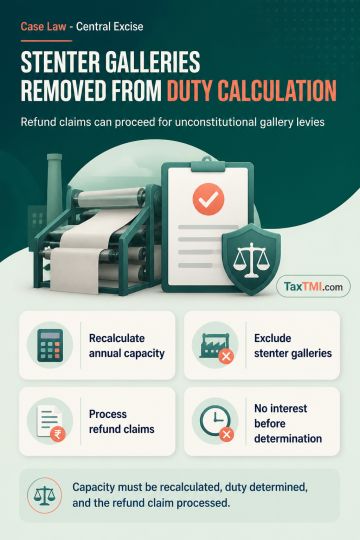
Annual production capacity determinations excluding stenter galleries support refunds for unconstitutional excise levies without an unjust-enrichment ...
Vicarious liability for cheque dishonour requires specific allegations of responsibility and cheque signatory; generic director allegations cannot sus...
IT Resilience Index requires market infrastructure institutions to automate resilience scoring, early warnings, and continuous service-delivery monito...
ITAT partially allowed the assessee's appeal regarding amounts found in a diary and surrendered by a director. The Tribunal held that since the surrendered amount represented gross undisclosed income rather than net profit, a lump sum addition of 10 lacs (out of 1.35 crores) was appropriate to cover potential revenue leakage while acknowledging expenditures incurred. Regarding accounting methods, ITAT ruled in favor of the assessee's use of the project completion method rather than percentage completion method. The Tribunal noted this method had been consistently followed and previously accepted by revenue authorities. The Tribunal recognized that immovable property transfers are governed by the Transfer of Property Act, where transfers are complete only upon full payment and possession, making the project completion method appropriate for revenue recognition.
ITAT partially allowed the assessee's appeal regarding amounts found in a diary and surrendered by a director. The Tribunal held that since the surrendered amount represented gross undisclosed income rather than net profit, a lump sum addition of 10 lacs (out of 1.35 crores) was appropriate to cover potential revenue leakage while acknowledging expenditures incurred. Regarding accounting methods, ITAT ruled in favor of the assessee's use of the project completion method rather than percentage completion method. The Tribunal noted this method had been consistently followed and previously accepted by revenue authorities. The Tribunal recognized that immovable property transfers are governed by the Transfer of Property Act, where transfers are complete only upon full payment and possession, making the project completion method appropriate for revenue recognition.
Note: It is a system-generated summary and is for quick reference only.
 TaxTMI
  TaxTMI
 of 4828


















 Join Channel