Service of notice and contractual debt acknowledgment preserved insolvency admission against a corporate guarantor despite limitation and natural just...
Original works exemption excludes standalone boulder transportation, leaving subcontracted railway-project transport services subject to service tax l...
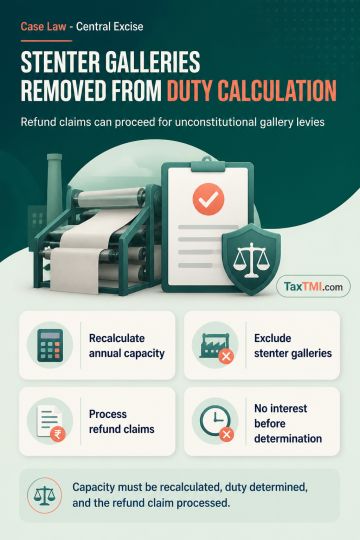
Annual production capacity determinations excluding stenter galleries support refunds for unconstitutional excise levies without an unjust-enrichment ...
Vicarious liability for cheque dishonour requires specific allegations of responsibility and cheque signatory; generic director allegations cannot sus...
IT Resilience Index requires market infrastructure institutions to automate resilience scoring, early warnings, and continuous service-delivery monito...
CESTAT ruled that pan masala and gutkha exports could not be classified as "prohibited goods" merely for non-declaration of technical characteristics of inputs on shipping bills as required under DFIA scheme. The Tribunal found that Revenue failed to establish any export prohibition for these products or prove that exported goods were "resultant products" of duty-free imported inputs. Since conditions allegedly violated pertained to imports rather than exports, and appellants claimed no duty exemption on exports, confiscation was unjustified. The Tribunal emphasized that non-compliance with DFIA conditions might affect duty-free import eligibility but cannot render freely exportable goods as prohibited. Consequently, both the confiscation order and penalties under Sec. 113(1) were set aside, and the appeal was allowed.
CESTAT ruled that pan masala and gutkha exports could not be classified as "prohibited goods" merely for non-declaration of technical characteristics of inputs on shipping bills as required under DFIA scheme. The Tribunal found that Revenue failed to establish any export prohibition for these products or prove that exported goods were "resultant products" of duty-free imported inputs. Since conditions allegedly violated pertained to imports rather than exports, and appellants claimed no duty exemption on exports, confiscation was unjustified. The Tribunal emphasized that non-compliance with DFIA conditions might affect duty-free import eligibility but cannot render freely exportable goods as prohibited. Consequently, both the confiscation order and penalties under Sec. 113(1) were set aside, and the appeal was allowed.
Note: It is a system-generated summary and is for quick reference only.
 TaxTMI
  TaxTMI
 of 4828















 Join Channel