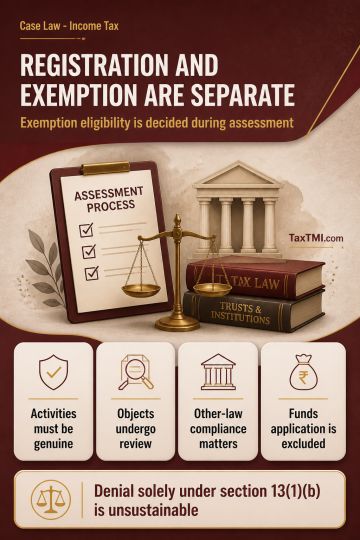
Defined public benefit can retain charitable character; registration renewal requires examining genuine activities and legal compliance, not surplus a...
Capital reduction is distinct from share buy-back, preventing buy-back tax; restructuring interest and related business deductions also survive scruti...
Transfer pricing and tax deductions upheld on established principles, while employee contributions and warranty provisions returned for fresh examinat...
Captive transfer pricing relies on industrial consumer tariffs, while genuine quotations can benchmark effluent treatment transfers under the Other Me...
Specific tariff classification for ophthalmic instruments and extended limitation principles determine the treatment of duty demands, confiscation, an...
Page of 4801
Press 'Enter' after typing page number.
1161 to 1180 of 96001 Results
❮
❯
❯❯
0 / 200
Expand Note
Add to Folder
No Folders have been created
+
Are you sure you want to delete "My most important" ?
The HC ruled that Section 25A of the KVAT Act, despite its non-obstante clause, merely provides an additional ground for reassessment and does not override the limitation period under Section 25(1). When the Assessing Officer receives a CAG objection, they must determine its lawfulness after giving the dealer an opportunity to be heard. If satisfied, reassessment must still follow the statutory procedure under Section 25(1), including adherence to limitation periods. The Revenue cannot circumvent time-barred assessments by initiating reassessment based on subsequent CAG reports. The court dismissed the State's O.T. Revisions and Writ Appeal, affirming that procedural due process in taxation cannot be inferred but must be explicitly provided in statute.
The HC ruled that Section 25A of the KVAT Act, despite its non-obstante clause, merely provides an additional ground for reassessment and does not override the limitation period under Section 25(1). When the Assessing Officer receives a CAG objection, they must determine its lawfulness after giving the dealer an opportunity to be heard. If satisfied, reassessment must still follow the statutory procedure under Section 25(1), including adherence to limitation periods. The Revenue cannot circumvent time-barred assessments by initiating reassessment based on subsequent CAG reports. The court dismissed the State's O.T. Revisions and Writ Appeal, affirming that procedural due process in taxation cannot be inferred but must be explicitly provided in statute.
Note: It is a system-generated summary and is for quick reference only.
 TaxTMI
 of 4801



















 Join Channel


 TaxTMI

