GST refunds for cancelled air tickets remain available when passenger reimbursements defeat unjust enrichment and credit-note adjustment is unavailabl...
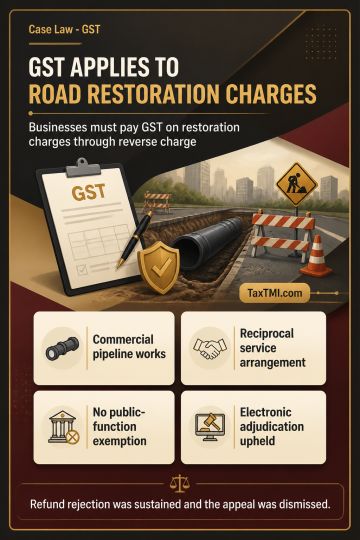
Request-driven road restoration attracts reverse-charge GST, not governmental-function treatment or compensatory-damages status for business recipient...
Road restoration charges for commercial pipeline works are taxable Government services, with reverse charge liability and no public-function exemption...
The ITAT ruled against the transfer pricing adjustment for AMP expenses, finding tax authorities failed to demonstrate that such expenses benefited the foreign AE's brand. The Tribunal held that AMP expenditure quantum alone cannot establish benefit to AEs, as brands are customer-centric rather than product-centric. Regarding royalty payments, the ITAT found the TPO's rejection of comparable agreements unjustified. Issues concerning management service fees, interest on outstanding receivables, and payments to 'Dart' were remanded to the AO/TPO for fresh determination in accordance with precedents from earlier assessment years and relevant case law, including Kusum Healthcare. All grounds were sustained either substantively or for statistical purposes.
The ITAT ruled against the transfer pricing adjustment for AMP expenses, finding tax authorities failed to demonstrate that such expenses benefited the foreign AE's brand. The Tribunal held that AMP expenditure quantum alone cannot establish benefit to AEs, as brands are customer-centric rather than product-centric. Regarding royalty payments, the ITAT found the TPO's rejection of comparable agreements unjustified. Issues concerning management service fees, interest on outstanding receivables, and payments to 'Dart' were remanded to the AO/TPO for fresh determination in accordance with precedents from earlier assessment years and relevant case law, including Kusum Healthcare. All grounds were sustained either substantively or for statistical purposes.
Note: It is a system-generated summary and is for quick reference only.
 TaxTMI
  TaxTMI
 of 4920