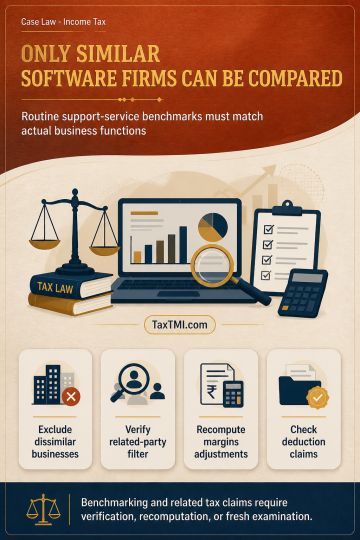
Functional comparability governs software-service benchmarking: dissimilar companies are excluded, while related-party filters, margins and working-ca...
The ITAT allowed the appellant's appeal, deleting the Rs. 10,00,000/- penalty imposed under Section 43 of the Black Money Act. The Tribunal found that the appellant, a British citizen who was only a tax resident in India for the relevant assessment year, had disclosed the foreign asset in a timely filed revised return. The revenue authorities failed to establish that the appellant was previously an Indian citizen or that the foreign investment involved undisclosed income from India. Relying on K Mohammad Haris and Rohit Krishna precedents, the ITAT concluded that the legislative intent of the Black Money Act was not applicable in this case, as there was proper disclosure within the prescribed time limit.
The ITAT allowed the appellant's appeal, deleting the Rs. 10,00,000/- penalty imposed under Section 43 of the Black Money Act. The Tribunal found that the appellant, a British citizen who was only a tax resident in India for the relevant assessment year, had disclosed the foreign asset in a timely filed revised return. The revenue authorities failed to establish that the appellant was previously an Indian citizen or that the foreign investment involved undisclosed income from India. Relying on K Mohammad Haris and Rohit Krishna precedents, the ITAT concluded that the legislative intent of the Black Money Act was not applicable in this case, as there was proper disclosure within the prescribed time limit.
Note: It is a system-generated summary and is for quick reference only.
 TaxTMI
  TaxTMI
 of 4828




















 Join Channel


