Statutory transfer formalities invalidated alleged share and property transfers, while retrospective record manipulation constituted oppression and mi...
Provisional attachment of laundered funds and equivalent-value property sustained, with statutory protection limited to pension, gratuity and providen...
Insolvency moratorium does not shield company officers from cheque dishonour prosecution for liability arising before corporate insolvency proceedings...
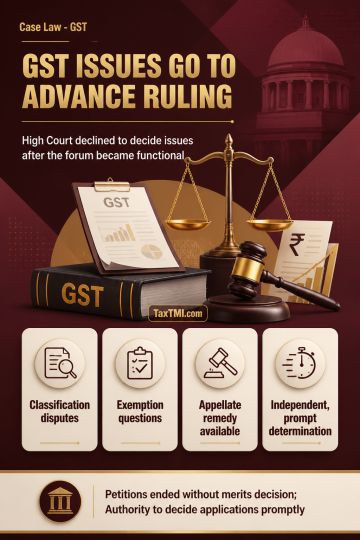
Advance-ruling mechanism governs pending GST classification, exemption and taxability disputes, limiting writ review once the specialised forum functi...
Page of 4805
Press 'Enter' after typing page number.
921 to 940 of 96092 Results
❮
❯
❯❯
0 / 200
Expand Note
Add to Folder
No Folders have been created
+
Are you sure you want to delete "My most important" ?
The HC upheld a transfer order under s.127(2) of the Income Tax Act relocating the petitioner's case from Mumbai to New Delhi. The court found substantial compliance with statutory requirements, noting proper consultation and agreement between Principal Commissioners and Chief Commissioners. The transfer was justified on merits to facilitate centralization of cases connected to the Pacific Group, where revenue evasion necessitated consolidated investigation. The court declined to exercise its extraordinary jurisdiction under Article 226, emphasizing that such discretionary power is reserved for promoting justice rather than addressing mere legal technicalities, particularly when jurisdictional parameters have been satisfied. The writ petition was accordingly dismissed.
The HC upheld a transfer order under s.127(2) of the Income Tax Act relocating the petitioner's case from Mumbai to New Delhi. The court found substantial compliance with statutory requirements, noting proper consultation and agreement between Principal Commissioners and Chief Commissioners. The transfer was justified on merits to facilitate centralization of cases connected to the Pacific Group, where revenue evasion necessitated consolidated investigation. The court declined to exercise its extraordinary jurisdiction under Article 226, emphasizing that such discretionary power is reserved for promoting justice rather than addressing mere legal technicalities, particularly when jurisdictional parameters have been satisfied. The writ petition was accordingly dismissed.
Note: It is a system-generated summary and is for quick reference only.
 TaxTMI
 of 4805















 Join Channel


 TaxTMI