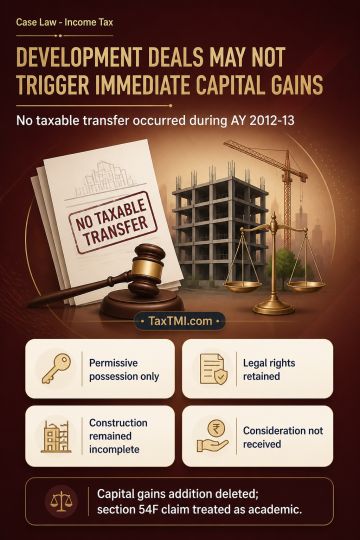
Development agreements require legal possession or effective enjoyment for capital gains transfer; permissive possession and deferred consideration de...
Prolonged sterilisation of development rights supports capital-gains treatment, while business-income disallowances cannot govern capital-gains comput...
Additional evidence in transfer pricing dispute leads to fresh examination, while tax deductions, TDS credit, fee and refund interest require verifica...
Category II AIF pass-through taxation preserves non-business income character; investment receipts cannot be reclassified without applying recognised ...
The HC ruled in favor of the petitioner, ordering the release of seized goods upon deposit of the valuation amount. The court found that the respondent failed to provide notice of extension before the six-month seizure period expired, violating Section 67(7) of the CGST Act. The court rejected the respondent's claim of "sufficient cause" based on documents not in the public domain, which denied the petitioner opportunity to respond. The HC emphasized that delayed valuation despite the assessee's cooperation cannot constitute "sufficient cause" for extending seizure. The court clarified that confiscation under Section 130 cannot be equated with seizure powers under Section 67, and that affected parties must be shown "sufficient cause" with proper notice and hearing rights.
The HC ruled in favor of the petitioner, ordering the release of seized goods upon deposit of the valuation amount. The court found that the respondent failed to provide notice of extension before the six-month seizure period expired, violating Section 67(7) of the CGST Act. The court rejected the respondent's claim of "sufficient cause" based on documents not in the public domain, which denied the petitioner opportunity to respond. The HC emphasized that delayed valuation despite the assessee's cooperation cannot constitute "sufficient cause" for extending seizure. The court clarified that confiscation under Section 130 cannot be equated with seizure powers under Section 67, and that affected parties must be shown "sufficient cause" with proper notice and hearing rights.
Note: It is a system-generated summary and is for quick reference only.
 TaxTMI
 of 4805
















 Join Channel


 TaxTMI
