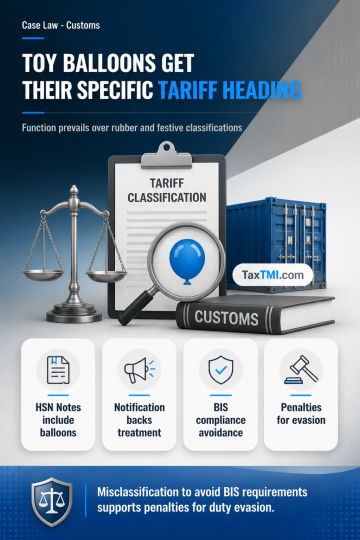
Toy balloon tariff classification: functional heading prevails over residual rubber and festive article headings, supporting penalties for deliberate ...
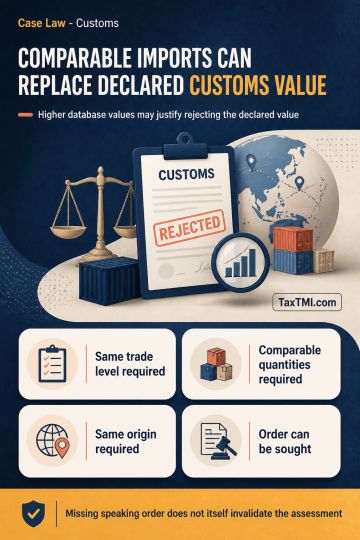
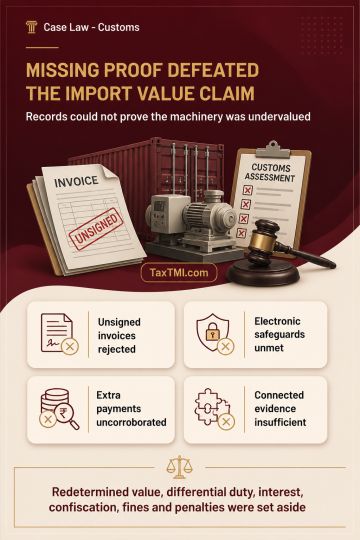
Customs valuation using comparable contemporaneous imports can displace declared value, while missing speaking orders require pursuit before competent...
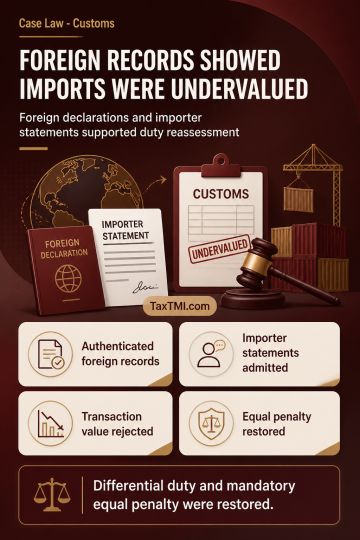
Foreign customs declarations and importer admissions established undervaluation, supporting sequential value redetermination, differential duty, and m...
Customs seizure safeguards prevent detention-based limitation avoidance and invalidate provisional release conditions for imported vehicles under an i...
Page of 4828
Press 'Enter' after typing page number.
361 to 380 of 96556 Results
❮
❯
❯❯
0 / 200
Expand Note
Add to Folder
No Folders have been created
+
Are you sure you want to delete "My most important" ?
HC dismissed the petition challenging the rejection of a request for relaxation under Rule 9C read with Section 72A regarding carry-forward of losses from amalgamated companies. The court determined that the petitioner failed to achieve the required production capacity (50%) even during the requested three-year extension period. The court emphasized that Section 72A's objective is not merely to encourage corporate restructuring but to extend benefits only where amalgamating companies' industrial undertakings are genuinely revived or continued. The petitioner's multiple requests to modify conditions-first seeking time extensions and later requesting reduced production thresholds (from 50% to 36-42%)-were found unmeritorious, as the application was filed just one day before the expiry of the four-year post-amalgamation period.
HC dismissed the petition challenging the rejection of a request for relaxation under Rule 9C read with Section 72A regarding carry-forward of losses from amalgamated companies. The court determined that the petitioner failed to achieve the required production capacity (50%) even during the requested three-year extension period. The court emphasized that Section 72A's objective is not merely to encourage corporate restructuring but to extend benefits only where amalgamating companies' industrial undertakings are genuinely revived or continued. The petitioner's multiple requests to modify conditions-first seeking time extensions and later requesting reduced production thresholds (from 50% to 36-42%)-were found unmeritorious, as the application was filed just one day before the expiry of the four-year post-amalgamation period.
Note: It is a system-generated summary and is for quick reference only.
 TaxTMI
  TaxTMI
 of 4828










 Join Channel