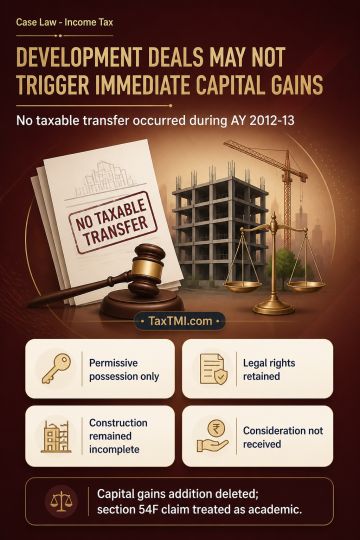
Development agreements require legal possession or effective enjoyment for capital gains transfer; permissive possession and deferred consideration de...
Prolonged sterilisation of development rights supports capital-gains treatment, while business-income disallowances cannot govern capital-gains comput...
Additional evidence in transfer pricing dispute leads to fresh examination, while tax deductions, TDS credit, fee and refund interest require verifica...
Category II AIF pass-through taxation preserves non-business income character; investment receipts cannot be reclassified without applying recognised ...
Mutual fund maturity rules require proper rollover, redemption, disclosure, and due diligence; investor gains cannot excuse regulatory breaches or pen...
The ITAT ruled in favor of the Revenue regarding the classification of government financial aid. Applying the "purpose test" established in Serum Institute of India Private Limited v. Union of India, the Tribunal determined that subsidies helping an assessee operate business more profitably or meet daily expenses constitute taxable revenue receipts, while those for establishing new units or expansion qualify as non-taxable capital receipts. The Finance Act, 2015 amendment to Section 2(24)(xviii) further clarified that all government assistance (subsidies, grants, incentives, etc.) constitutes taxable income unless specifically used to determine an asset's actual cost. Based on these principles, the Revenue's appeal was allowed.
The ITAT ruled in favor of the Revenue regarding the classification of government financial aid. Applying the "purpose test" established in Serum Institute of India Private Limited v. Union of India, the Tribunal determined that subsidies helping an assessee operate business more profitably or meet daily expenses constitute taxable revenue receipts, while those for establishing new units or expansion qualify as non-taxable capital receipts. The Finance Act, 2015 amendment to Section 2(24)(xviii) further clarified that all government assistance (subsidies, grants, incentives, etc.) constitutes taxable income unless specifically used to determine an asset's actual cost. Based on these principles, the Revenue's appeal was allowed.
Note: It is a system-generated summary and is for quick reference only.
 TaxTMI
 of 4796


















 Join Channel


 TaxTMI

