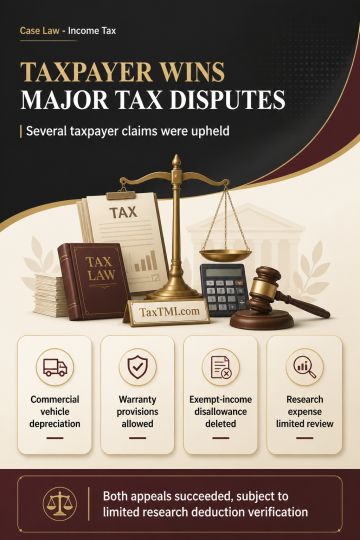
Commercial vehicle depreciation, scientifically determined warranty provisions and exempt-income disallowances were resolved in favour of the taxpayer...
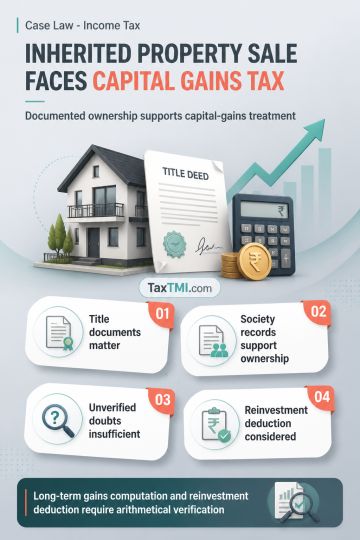
Inherited property sale proceeds require capital-gains treatment where ownership is supported by evidence, not suspicion or unverified signature doubt...
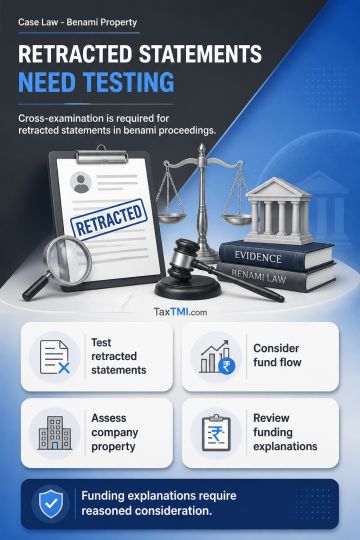
Cross-examination of retracted statements is essential where foundational evidence supports a benami allegation and documented funding explanations re...
Capital-goods exemption covers plant-modernisation accessories, while the import restriction applies only to earlier capital-goods components and spar...
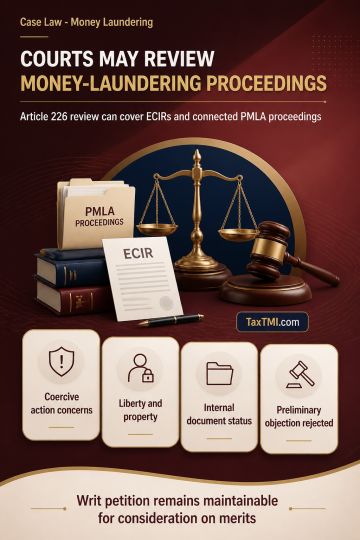
Constitutional judicial review permits challenges to ECIRs and connected money-laundering proceedings where coercive action affects fundamental intere...
The ITAT ruled in favor of the Revenue regarding the classification of government financial aid. Applying the "purpose test" established in Serum Institute of India Private Limited v. Union of India, the Tribunal determined that subsidies helping an assessee operate business more profitably or meet daily expenses constitute taxable revenue receipts, while those for establishing new units or expansion qualify as non-taxable capital receipts. The Finance Act, 2015 amendment to Section 2(24)(xviii) further clarified that all government assistance (subsidies, grants, incentives, etc.) constitutes taxable income unless specifically used to determine an asset's actual cost. Based on these principles, the Revenue's appeal was allowed.
The ITAT ruled in favor of the Revenue regarding the classification of government financial aid. Applying the "purpose test" established in Serum Institute of India Private Limited v. Union of India, the Tribunal determined that subsidies helping an assessee operate business more profitably or meet daily expenses constitute taxable revenue receipts, while those for establishing new units or expansion qualify as non-taxable capital receipts. The Finance Act, 2015 amendment to Section 2(24)(xviii) further clarified that all government assistance (subsidies, grants, incentives, etc.) constitutes taxable income unless specifically used to determine an asset's actual cost. Based on these principles, the Revenue's appeal was allowed.
Note: It is a system-generated summary and is for quick reference only.
 TaxTMI
 of 4782






 Join Channel


 TaxTMI
