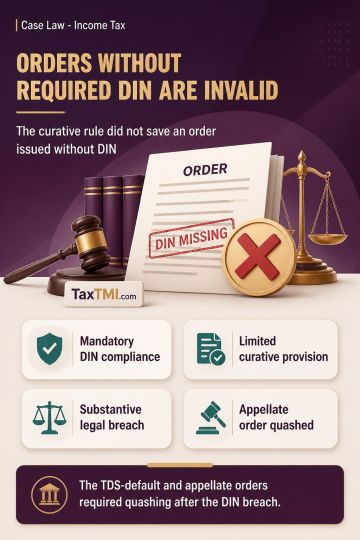
Document Identification Number compliance renders TDS-default orders invalid where mandatory DIN requirements are breached and curative provision does...
HC held that Extra Duty Deposit (EDD) does not constitute customs duty under Section 27 of Customs Act, 1962, but rather functions as a security deposit as clarified in Circular No.5/2016-Customs. EDD was collected to secure potential customs duty liability due to alleged under-declaration concerns. The limitation period prescribed under Section 27 for customs duty refund claims is not applicable to EDD refunds. The court rejected respondent's stance that refund application was time-barred, noting that EDD remained distinct from duty determined by Special Valuation Branch. The impugned order's reliance on limitation period was found legally untenable, leading to petition's allowance.
HC held that Extra Duty Deposit (EDD) does not constitute customs duty under Section 27 of Customs Act, 1962, but rather functions as a security deposit as clarified in Circular No.5/2016-Customs. EDD was collected to secure potential customs duty liability due to alleged under-declaration concerns. The limitation period prescribed under Section 27 for customs duty refund claims is not applicable to EDD refunds. The court rejected respondent's stance that refund application was time-barred, noting that EDD remained distinct from duty determined by Special Valuation Branch. The impugned order's reliance on limitation period was found legally untenable, leading to petition's allowance.
Note: It is a system-generated summary and is for quick reference only.
 TaxTMI
  TaxTMI
 of 4918