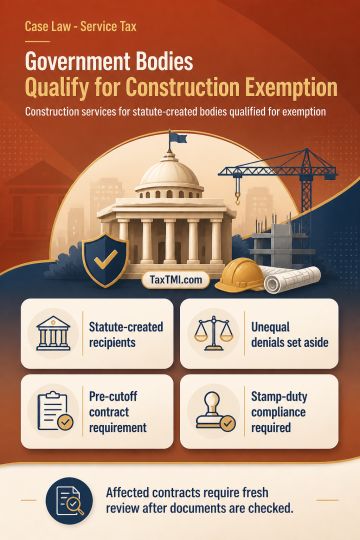
Governmental authority status supports construction-service exemption, while pre-cutoff contract and stamp-duty compliance requires verification on re...
Automated Free Sale and Commerce Certificates enable paperless processing while retaining risk-based manual verification for selected exporter applica...
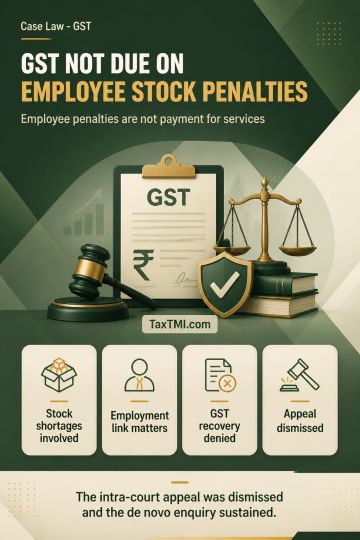
Employee stock-shortage penalties do not constitute consideration for services, preventing GST collection under Schedule II in employment relationship...
The Income Tax Bill, 2025 restructures the definition of "salary" through Clause 16, introducing significant organizational improvements over Section 17(1) of the Income-tax Act, 1961. The revised framework expands from 9 to 12 sub-clauses, providing clearer categorization of salary components including fees, commissions, perquisites, and profits. Key modifications include separate treatment of previously combined elements, updated references to pension schemes and provident funds, and retention of provisions for the Agniveer Corpus Fund. While maintaining fundamental taxation principles, the new structure offers enhanced clarity for employers, employees, and tax administrators through better segregation of compensation components and modernized classification systems. The changes represent an evolutionary refinement focused on improved organization rather than substantive alterations to salary taxation mechanisms.
The Income Tax Bill, 2025 restructures the definition of "salary" through Clause 16, introducing significant organizational improvements over Section 17(1) of the Income-tax Act, 1961. The revised framework expands from 9 to 12 sub-clauses, providing clearer categorization of salary components including fees, commissions, perquisites, and profits. Key modifications include separate treatment of previously combined elements, updated references to pension schemes and provident funds, and retention of provisions for the Agniveer Corpus Fund. While maintaining fundamental taxation principles, the new structure offers enhanced clarity for employers, employees, and tax administrators through better segregation of compensation components and modernized classification systems. The changes represent an evolutionary refinement focused on improved organization rather than substantive alterations to salary taxation mechanisms.
Note: It is a system-generated summary and is for quick reference only.
 TaxTMI
  TaxTMI
 of 4828














 Join Channel


