Service of notice and contractual debt acknowledgment preserved insolvency admission against a corporate guarantor despite limitation and natural just...
Original works exemption excludes standalone boulder transportation, leaving subcontracted railway-project transport services subject to service tax l...
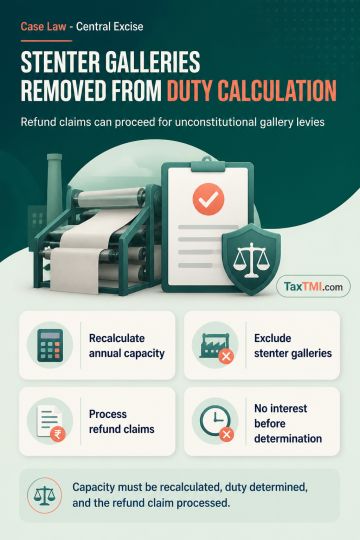
Annual production capacity determinations excluding stenter galleries support refunds for unconstitutional excise levies without an unjust-enrichment ...
Vicarious liability for cheque dishonour requires specific allegations of responsibility and cheque signatory; generic director allegations cannot sus...
IT Resilience Index requires market infrastructure institutions to automate resilience scoring, early warnings, and continuous service-delivery monito...
HC held that receiving Rs. 1.5 crore in cash violating Section 269ST of Income Tax Act does not render the underlying collaboration agreement void. While Section 271DA imposes penalty on cash recipients, it only prescribes fiscal penalties without invalidating the transaction. The defendant, being solely culpable as recipient, cannot invoke statutory violation to escape liability. Following the principle established that 'in pari delicto' applies only when both parties share equal responsibility for illegality, the defendant cannot retain money under guise of statutory violation when penal liability rests solely with them. The determination of tax violations falls under Income Tax Authorities' jurisdiction per Section 271D, and absent proven tax evasion intent, no statutory bar prevents civil recovery proceedings. Application under Order VII Rule 11(d) CPC rejected.
HC held that receiving Rs. 1.5 crore in cash violating Section 269ST of Income Tax Act does not render the underlying collaboration agreement void. While Section 271DA imposes penalty on cash recipients, it only prescribes fiscal penalties without invalidating the transaction. The defendant, being solely culpable as recipient, cannot invoke statutory violation to escape liability. Following the principle established that 'in pari delicto' applies only when both parties share equal responsibility for illegality, the defendant cannot retain money under guise of statutory violation when penal liability rests solely with them. The determination of tax violations falls under Income Tax Authorities' jurisdiction per Section 271D, and absent proven tax evasion intent, no statutory bar prevents civil recovery proceedings. Application under Order VII Rule 11(d) CPC rejected.
Note: It is a system-generated summary and is for quick reference only.
 TaxTMI
  TaxTMI
 of 4828

















 Join Channel