Prolonged sterilisation of development rights supports capital-gains treatment, while business-income disallowances cannot govern capital-gains comput...
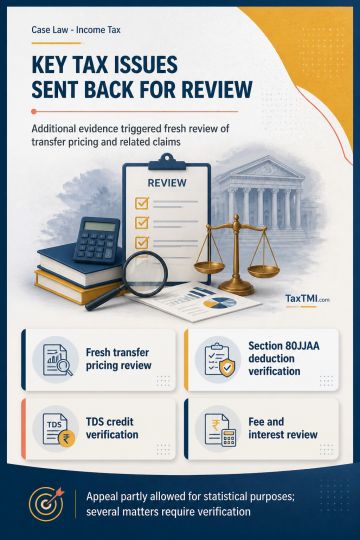
Additional evidence in transfer pricing dispute leads to fresh examination, while tax deductions, TDS credit, fee and refund interest require verifica...
Category II AIF pass-through taxation preserves non-business income character; investment receipts cannot be reclassified without applying recognised ...
Mutual fund maturity rules require proper rollover, redemption, disclosure, and due diligence; investor gains cannot excuse regulatory breaches or pen...
Threshold exemption excludes exempt services, while stamp-paper purchases avoid reverse charge; consequential service tax penalties were also set asid...
The Income Tax Bill 2025 establishes comprehensive criteria for income deemed to accrue or arise in India, focusing on four primary categories: income from Indian assets/sources, property, business connections, and capital asset transfers. The legislation introduces significant provisions for digital economy taxation through the Significant Economic Presence (SEP) concept, while maintaining traditional nexus rules. Key elements include expanded definitions of royalties encompassing digital rights, technical service fees excluding construction projects, and refined business connection tests. The framework incorporates substantial value derivation tests for indirect transfers, with specific exemptions for portfolio investors and small shareholders. This modernized approach aligns with OECD BEPS recommendations while preserving India's sovereign taxation rights, particularly in digital commerce and cross-border transactions.
The Income Tax Bill 2025 establishes comprehensive criteria for income deemed to accrue or arise in India, focusing on four primary categories: income from Indian assets/sources, property, business connections, and capital asset transfers. The legislation introduces significant provisions for digital economy taxation through the Significant Economic Presence (SEP) concept, while maintaining traditional nexus rules. Key elements include expanded definitions of royalties encompassing digital rights, technical service fees excluding construction projects, and refined business connection tests. The framework incorporates substantial value derivation tests for indirect transfers, with specific exemptions for portfolio investors and small shareholders. This modernized approach aligns with OECD BEPS recommendations while preserving India's sovereign taxation rights, particularly in digital commerce and cross-border transactions.
Note: It is a system-generated summary and is for quick reference only.
 TaxTMI
 of 4792




















 Join Channel


 TaxTMI
