Approved resolution plans extinguish unsubmitted pre-approval tax claims, preventing later recovery outside the insolvency process and preserving a cl...
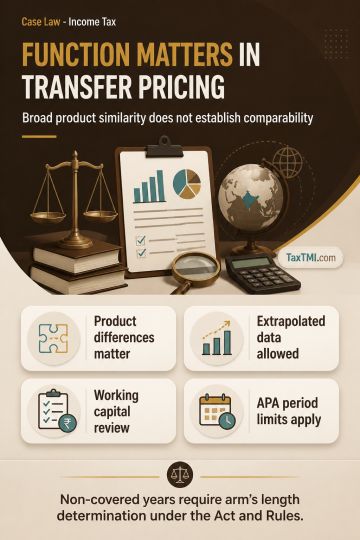
Transfer pricing comparability requires functional alignment and permits working capital adjustment, while APA margins cannot govern non-covered years...
Treaty benefit, goodwill depreciation and hedging costs: export commission disallowed, while key business deductions and depreciation claims succeeded...
The Income Tax Bill 2025 establishes comprehensive criteria for income deemed to accrue or arise in India, focusing on four primary categories: income from Indian assets/sources, property, business connections, and capital asset transfers. The legislation introduces significant provisions for digital economy taxation through the Significant Economic Presence (SEP) concept, while maintaining traditional nexus rules. Key elements include expanded definitions of royalties encompassing digital rights, technical service fees excluding construction projects, and refined business connection tests. The framework incorporates substantial value derivation tests for indirect transfers, with specific exemptions for portfolio investors and small shareholders. This modernized approach aligns with OECD BEPS recommendations while preserving India's sovereign taxation rights, particularly in digital commerce and cross-border transactions.
The Income Tax Bill 2025 establishes comprehensive criteria for income deemed to accrue or arise in India, focusing on four primary categories: income from Indian assets/sources, property, business connections, and capital asset transfers. The legislation introduces significant provisions for digital economy taxation through the Significant Economic Presence (SEP) concept, while maintaining traditional nexus rules. Key elements include expanded definitions of royalties encompassing digital rights, technical service fees excluding construction projects, and refined business connection tests. The framework incorporates substantial value derivation tests for indirect transfers, with specific exemptions for portfolio investors and small shareholders. This modernized approach aligns with OECD BEPS recommendations while preserving India's sovereign taxation rights, particularly in digital commerce and cross-border transactions.
Note: It is a system-generated summary and is for quick reference only.
 TaxTMI
 of 4784



















 Join Channel


 TaxTMI
