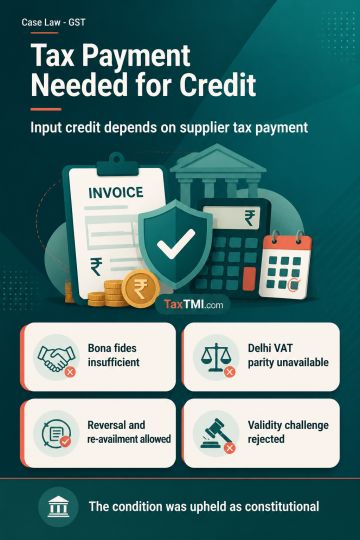
Input tax credit conditions remain constitutionally valid, with eligible recipient claims considered under GST circulars and retrospective filing dead...
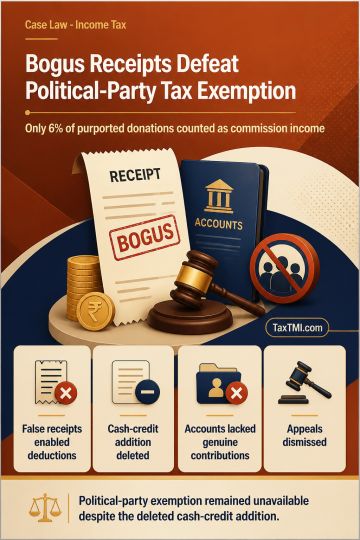
Bogus donation receipts justified commission income assessment and defeated political-party tax exemption for inaccurate accounts and reporting failur...
Pure reimbursement without income element escapes tax withholding, while delayed withholding and unsupported provisions face deferred or renewed scrut...
Public benefit requirement defeats charitable registration where residents' association services are reciprocal, member-only facilities governed by mu...
Exempt-income expenditure disallowance is confined to investments that actually generated exempt income, while supported business expenses remain dedu...
The Income Tax Bill 2025 establishes comprehensive criteria for income deemed to accrue or arise in India, focusing on four primary categories: income from Indian assets/sources, property, business connections, and capital asset transfers. The legislation introduces significant provisions for digital economy taxation through the Significant Economic Presence (SEP) concept, while maintaining traditional nexus rules. Key elements include expanded definitions of royalties encompassing digital rights, technical service fees excluding construction projects, and refined business connection tests. The framework incorporates substantial value derivation tests for indirect transfers, with specific exemptions for portfolio investors and small shareholders. This modernized approach aligns with OECD BEPS recommendations while preserving India's sovereign taxation rights, particularly in digital commerce and cross-border transactions.
The Income Tax Bill 2025 establishes comprehensive criteria for income deemed to accrue or arise in India, focusing on four primary categories: income from Indian assets/sources, property, business connections, and capital asset transfers. The legislation introduces significant provisions for digital economy taxation through the Significant Economic Presence (SEP) concept, while maintaining traditional nexus rules. Key elements include expanded definitions of royalties encompassing digital rights, technical service fees excluding construction projects, and refined business connection tests. The framework incorporates substantial value derivation tests for indirect transfers, with specific exemptions for portfolio investors and small shareholders. This modernized approach aligns with OECD BEPS recommendations while preserving India's sovereign taxation rights, particularly in digital commerce and cross-border transactions.
Note: It is a system-generated summary and is for quick reference only.
 TaxTMI
 of 4782




















 Join Channel


 TaxTMI