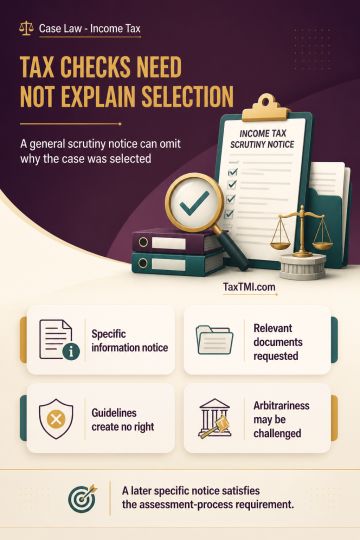
Authentication of paper assessment orders upheld, while qualifying repairs, consumables and vendor advance write-offs remain deductible business claim...
Transaction value cannot be rejected solely on non-statutory valuation guidelines without corroborative evidence supporting reassessment of final cust...
Cross-examination rights and corroborated evidence limit customs penalties for misdeclaration in genuine import transactions involving documented clea...
Tariff classification of vehicle gear components follows the specific gearing entry, displacing motor-vehicle parts classification and related liabili...
The Income Tax Bill 2025 establishes comprehensive criteria for income deemed to accrue or arise in India, focusing on four primary categories: income from Indian assets/sources, property, business connections, and capital asset transfers. The legislation introduces significant provisions for digital economy taxation through the Significant Economic Presence (SEP) concept, while maintaining traditional nexus rules. Key elements include expanded definitions of royalties encompassing digital rights, technical service fees excluding construction projects, and refined business connection tests. The framework incorporates substantial value derivation tests for indirect transfers, with specific exemptions for portfolio investors and small shareholders. This modernized approach aligns with OECD BEPS recommendations while preserving India's sovereign taxation rights, particularly in digital commerce and cross-border transactions.
The Income Tax Bill 2025 establishes comprehensive criteria for income deemed to accrue or arise in India, focusing on four primary categories: income from Indian assets/sources, property, business connections, and capital asset transfers. The legislation introduces significant provisions for digital economy taxation through the Significant Economic Presence (SEP) concept, while maintaining traditional nexus rules. Key elements include expanded definitions of royalties encompassing digital rights, technical service fees excluding construction projects, and refined business connection tests. The framework incorporates substantial value derivation tests for indirect transfers, with specific exemptions for portfolio investors and small shareholders. This modernized approach aligns with OECD BEPS recommendations while preserving India's sovereign taxation rights, particularly in digital commerce and cross-border transactions.
Note: It is a system-generated summary and is for quick reference only.
 TaxTMI
 of 4782

















 Join Channel


 TaxTMI

