Commercial vehicle depreciation, scientifically determined warranty provisions and exempt-income disallowances were resolved in favour of the taxpayer...
Inherited property sale proceeds require capital-gains treatment where ownership is supported by evidence, not suspicion or unverified signature doubt...
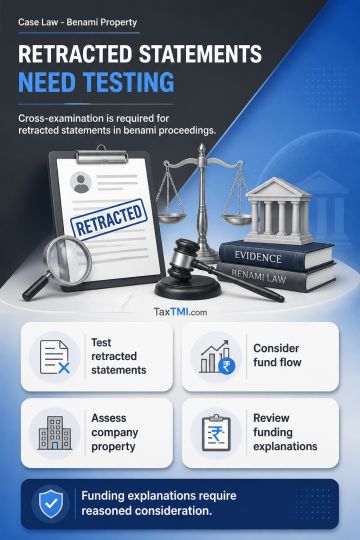
Cross-examination of retracted statements is essential where foundational evidence supports a benami allegation and documented funding explanations re...
Capital-goods exemption covers plant-modernisation accessories, while the import restriction applies only to earlier capital-goods components and spar...
Constitutional judicial review permits challenges to ECIRs and connected money-laundering proceedings where coercive action affects fundamental intere...
The Income Tax Bill 2025 consolidates and modernizes deemed income provisions previously contained in Sections 7 and 8 of ITA 1961. The new Clause 7 creates a unified framework dividing deemed income into two sub-clauses: employee benefits and dividend income. Key modifications include updated references to Schedule XI for provident funds, expanded scope of employer contributions, and refined dividend income treatment. The consolidation maintains essential provisions while improving organizational clarity through precise terminology and streamlined cross-references. The restructuring aims to reduce interpretational disputes and align with contemporary business practices, though initial implementation may require updated judicial precedents. The reform represents a systematic enhancement of deemed income provisions while preserving their fundamental characteristics.
The Income Tax Bill 2025 consolidates and modernizes deemed income provisions previously contained in Sections 7 and 8 of ITA 1961. The new Clause 7 creates a unified framework dividing deemed income into two sub-clauses: employee benefits and dividend income. Key modifications include updated references to Schedule XI for provident funds, expanded scope of employer contributions, and refined dividend income treatment. The consolidation maintains essential provisions while improving organizational clarity through precise terminology and streamlined cross-references. The restructuring aims to reduce interpretational disputes and align with contemporary business practices, though initial implementation may require updated judicial precedents. The reform represents a systematic enhancement of deemed income provisions while preserving their fundamental characteristics.
Note: It is a system-generated summary and is for quick reference only.
 TaxTMI
 of 4780






















 Join Channel


 TaxTMI
