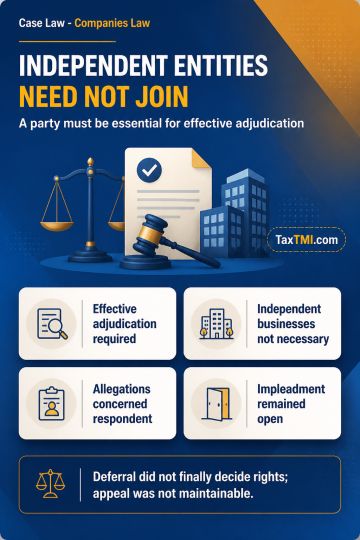
Necessary-party requirements limit impleadment of independent entities, while deferred consideration does not create an appealable adverse determinati...
Food supplement classification requires common parlance and authoritative tests, preventing treatment as proprietary Ayurvedic medicines without suppo...
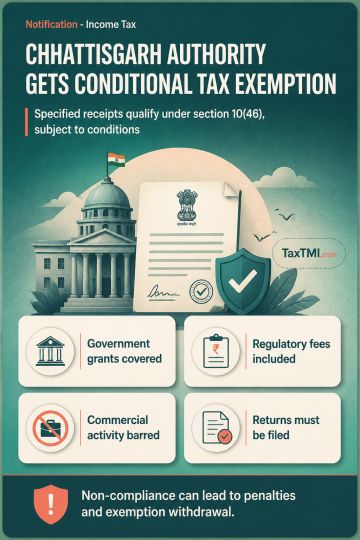
Specified regulatory authority income receives conditional tax exemption, subject to non-commercial activity, unchanged income character, and return f...
Tax exemption for regulatory authority income applies retrospectively, subject to non-commercial activity, unchanged income sources, and return-filing...
Input tax credit conditions remain constitutionally valid, with eligible recipient claims considered under GST circulars and retrospective filing dead...
The Income Tax Bill 2025 consolidates and modernizes deemed income provisions previously contained in Sections 7 and 8 of ITA 1961. The new Clause 7 creates a unified framework dividing deemed income into two sub-clauses: employee benefits and dividend income. Key modifications include updated references to Schedule XI for provident funds, expanded scope of employer contributions, and refined dividend income treatment. The consolidation maintains essential provisions while improving organizational clarity through precise terminology and streamlined cross-references. The restructuring aims to reduce interpretational disputes and align with contemporary business practices, though initial implementation may require updated judicial precedents. The reform represents a systematic enhancement of deemed income provisions while preserving their fundamental characteristics.
The Income Tax Bill 2025 consolidates and modernizes deemed income provisions previously contained in Sections 7 and 8 of ITA 1961. The new Clause 7 creates a unified framework dividing deemed income into two sub-clauses: employee benefits and dividend income. Key modifications include updated references to Schedule XI for provident funds, expanded scope of employer contributions, and refined dividend income treatment. The consolidation maintains essential provisions while improving organizational clarity through precise terminology and streamlined cross-references. The restructuring aims to reduce interpretational disputes and align with contemporary business practices, though initial implementation may require updated judicial precedents. The reform represents a systematic enhancement of deemed income provisions while preserving their fundamental characteristics.
Note: It is a system-generated summary and is for quick reference only.
 TaxTMI
 of 4784


















 Join Channel


 TaxTMI