Defined public benefit can retain charitable character; registration renewal requires examining genuine activities and legal compliance, not surplus a...
Capital reduction is distinct from share buy-back, preventing buy-back tax; restructuring interest and related business deductions also survive scruti...
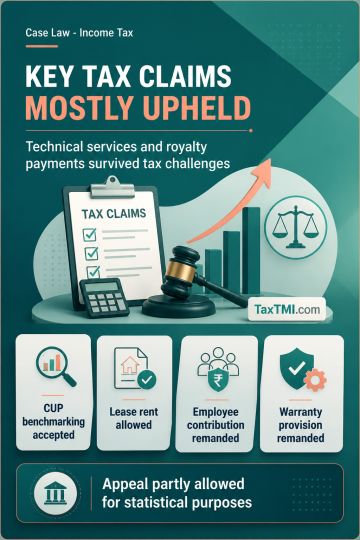
Transfer pricing and tax deductions upheld on established principles, while employee contributions and warranty provisions returned for fresh examinat...
Captive transfer pricing relies on industrial consumer tariffs, while genuine quotations can benchmark effluent treatment transfers under the Other Me...
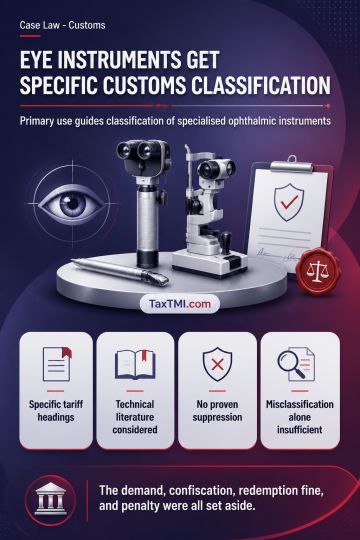
Specific tariff classification for ophthalmic instruments and extended limitation principles determine the treatment of duty demands, confiscation, an...
Page of 4801
Press 'Enter' after typing page number.
1161 to 1180 of 96001 Results
❮
❯
❯❯
0 / 200
Expand Note
Add to Folder
No Folders have been created
+
Are you sure you want to delete "My most important" ?
CESTAT examined taxation of retained freight portions from oil companies under business auxiliary services. The dispute centered on whether appellant's retention of "address commission" from vessel charter charges constituted taxable service. While service provider's location in India established territorial jurisdiction, the adjudicating authority failed to properly analyze whether retained amounts represented commission from overseas vessel owners rather than service charges to oil companies. The tribunal found inadequate consideration of Place of Provision Rules 2012 and legal basis for tax liability under Finance Act sections 66 and 66B. Matter remanded to original authority for fresh examination of tax applicability, contractual relationships, and proper characterization of retained amounts as either service consideration or overseas commission payments.
CESTAT examined taxation of retained freight portions from oil companies under business auxiliary services. The dispute centered on whether appellant's retention of "address commission" from vessel charter charges constituted taxable service. While service provider's location in India established territorial jurisdiction, the adjudicating authority failed to properly analyze whether retained amounts represented commission from overseas vessel owners rather than service charges to oil companies. The tribunal found inadequate consideration of Place of Provision Rules 2012 and legal basis for tax liability under Finance Act sections 66 and 66B. Matter remanded to original authority for fresh examination of tax applicability, contractual relationships, and proper characterization of retained amounts as either service consideration or overseas commission payments.
Note: It is a system-generated summary and is for quick reference only.
 TaxTMI
 of 4801




















 Join Channel


 TaxTMI