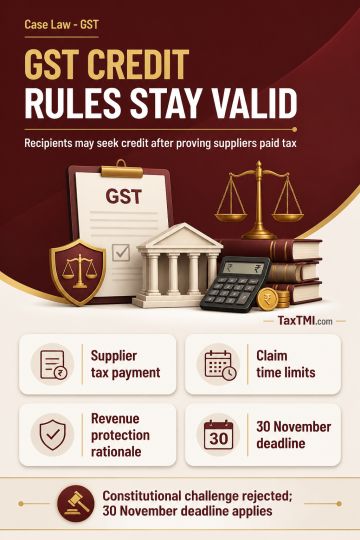
Input tax credit conditions remain constitutionally valid, with eligible recipient claims considered under GST circulars and retrospective filing dead...
Bogus donation receipts justified commission income assessment and defeated political-party tax exemption for inaccurate accounts and reporting failur...
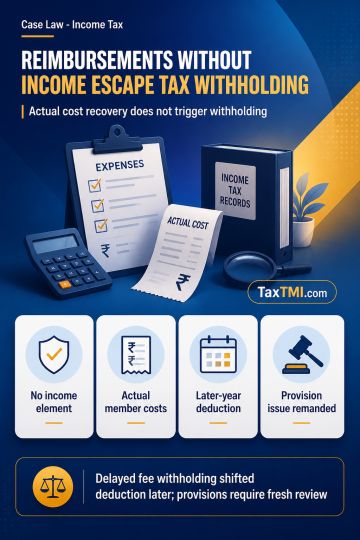
Pure reimbursement without income element escapes tax withholding, while delayed withholding and unsupported provisions face deferred or renewed scrut...
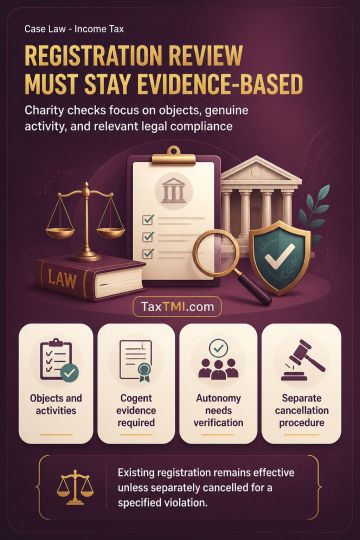
Public benefit requirement defeats charitable registration where residents' association services are reciprocal, member-only facilities governed by mu...
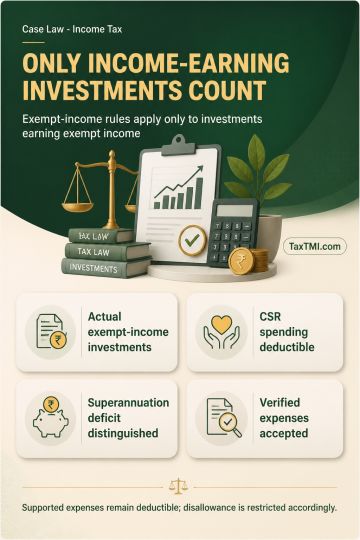
Exempt-income expenditure disallowance is confined to investments that actually generated exempt income, while supported business expenses remain dedu...
Page of 4796
Press 'Enter' after typing page number.
621 to 640 of 95918 Results
❮
❯
❯❯
0 / 200
Expand Note
Add to Folder
No Folders have been created
+
Are you sure you want to delete "My most important" ?
CESTAT ruled printed thermal paper ATM rolls are classifiable under Chapter 49 (CETH 49019900) as products of printing industry rather than Chapter 48 (CETH 48119099). The tribunal determined that printing on thermal rolls creates a distinct ATM roll product where the printed content (transaction details, instructions, logos) serves a primary rather than incidental purpose. The printed matter and blank portions constitute integrated elements serving informational purposes. Following precedents from similar cases involving thermal papers and printed materials, CESTAT held that when articles are printed, their primary purpose of conveying information makes them appropriately classifiable under heading 49.01. Appeal allowed in favor of the appellant.
CESTAT ruled printed thermal paper ATM rolls are classifiable under Chapter 49 (CETH 49019900) as products of printing industry rather than Chapter 48 (CETH 48119099). The tribunal determined that printing on thermal rolls creates a distinct ATM roll product where the printed content (transaction details, instructions, logos) serves a primary rather than incidental purpose. The printed matter and blank portions constitute integrated elements serving informational purposes. Following precedents from similar cases involving thermal papers and printed materials, CESTAT held that when articles are printed, their primary purpose of conveying information makes them appropriately classifiable under heading 49.01. Appeal allowed in favor of the appellant.
Note: It is a system-generated summary and is for quick reference only.
 TaxTMI
 of 4796













 Join Channel


 TaxTMI