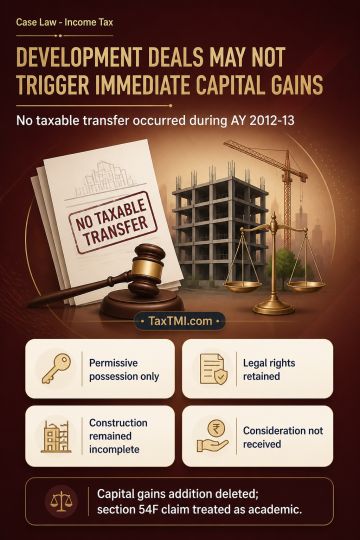
Development agreements require legal possession or effective enjoyment for capital gains transfer; permissive possession and deferred consideration de...
Prolonged sterilisation of development rights supports capital-gains treatment, while business-income disallowances cannot govern capital-gains comput...
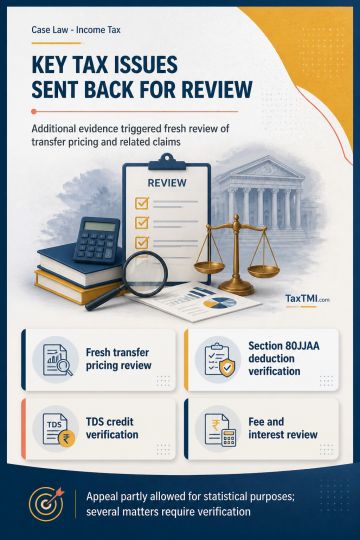
Additional evidence in transfer pricing dispute leads to fresh examination, while tax deductions, TDS credit, fee and refund interest require verifica...
Category II AIF pass-through taxation preserves non-business income character; investment receipts cannot be reclassified without applying recognised ...
Mutual fund maturity rules require proper rollover, redemption, disclosure, and due diligence; investor gains cannot excuse regulatory breaches or pen...
ITAT ruled against penalty under Section 271D for alleged violation of Section 269SS regarding cash transactions in property transfer. The Tribunal held that while Section 269SS applies broadly to property transfers beyond simple buy-sell transactions, it targets actual recipients of funds, not intermediaries. The appellant, acting as a broker, merely facilitated payments between principals and wasn't the true recipient. Additionally, ITAT found reasonable cause under Section 273B, noting the relevant amendment to Section 269SS occurred after the transaction date. The appellant's limited education and role as middleman demonstrated absence of malafide intent. The Tribunal directed deletion of penalty, allowing the appeal.
ITAT ruled against penalty under Section 271D for alleged violation of Section 269SS regarding cash transactions in property transfer. The Tribunal held that while Section 269SS applies broadly to property transfers beyond simple buy-sell transactions, it targets actual recipients of funds, not intermediaries. The appellant, acting as a broker, merely facilitated payments between principals and wasn't the true recipient. Additionally, ITAT found reasonable cause under Section 273B, noting the relevant amendment to Section 269SS occurred after the transaction date. The appellant's limited education and role as middleman demonstrated absence of malafide intent. The Tribunal directed deletion of penalty, allowing the appeal.
Note: It is a system-generated summary and is for quick reference only.
 TaxTMI
 of 4807














 Join Channel


 TaxTMI