Development agreements require legal possession or effective enjoyment for capital gains transfer; permissive possession and deferred consideration de...
Prolonged sterilisation of development rights supports capital-gains treatment, while business-income disallowances cannot govern capital-gains comput...
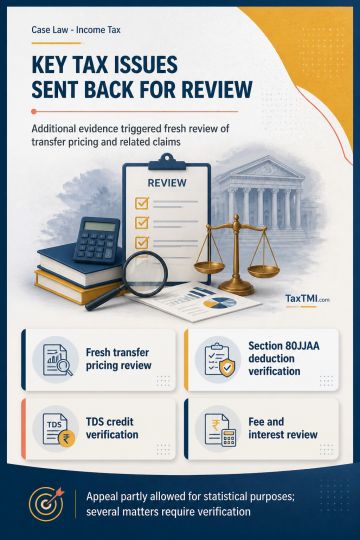
Additional evidence in transfer pricing dispute leads to fresh examination, while tax deductions, TDS credit, fee and refund interest require verifica...
Category II AIF pass-through taxation preserves non-business income character; investment receipts cannot be reclassified without applying recognised ...
ITAT ruled favorably on multiple issues for the banking assessee. The tribunal allowed deduction under s.36(1)(viia) for NPA provisions, holding them equivalent to provisions for bad and doubtful debts. For s.14A disallowance, matter was remanded to examine administrative expenses allocation despite interest-free funds exceeding investments. Deduction under s.36(1)(vii) was permitted following prior precedent. RBI penalty payment was deemed allowable under s.37 as not being for legal infraction. Interest on Innovative Perpetual Debt Instruments (IPDI) qualified for deduction under s.36(1)(iii), recognizing these hybrid instruments as legitimate business borrowings despite their perpetual nature and discretionary payout features. The ruling primarily followed established banking sector precedents and emphasized substance over form.
ITAT ruled favorably on multiple issues for the banking assessee. The tribunal allowed deduction under s.36(1)(viia) for NPA provisions, holding them equivalent to provisions for bad and doubtful debts. For s.14A disallowance, matter was remanded to examine administrative expenses allocation despite interest-free funds exceeding investments. Deduction under s.36(1)(vii) was permitted following prior precedent. RBI penalty payment was deemed allowable under s.37 as not being for legal infraction. Interest on Innovative Perpetual Debt Instruments (IPDI) qualified for deduction under s.36(1)(iii), recognizing these hybrid instruments as legitimate business borrowings despite their perpetual nature and discretionary payout features. The ruling primarily followed established banking sector precedents and emphasized substance over form.
Note: It is a system-generated summary and is for quick reference only.
 TaxTMI
 of 4805

















 Join Channel


 TaxTMI
