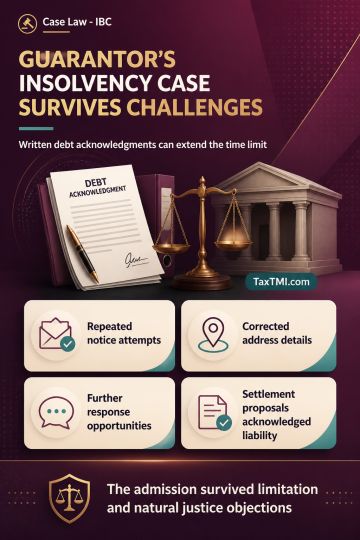
Service of notice and contractual debt acknowledgment preserved insolvency admission against a corporate guarantor despite limitation and natural just...
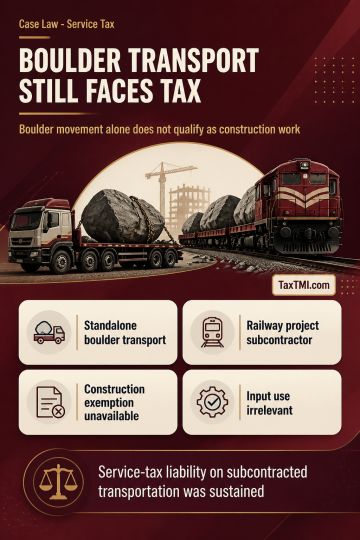
Original works exemption excludes standalone boulder transportation, leaving subcontracted railway-project transport services subject to service tax l...
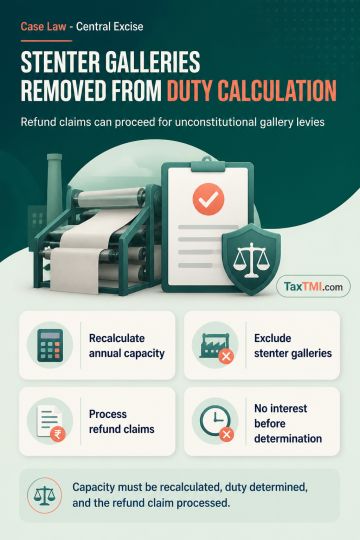
Annual production capacity determinations excluding stenter galleries support refunds for unconstitutional excise levies without an unjust-enrichment ...
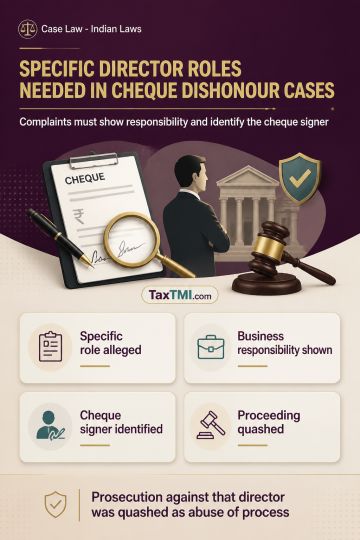
Vicarious liability for cheque dishonour requires specific allegations of responsibility and cheque signatory; generic director allegations cannot sus...
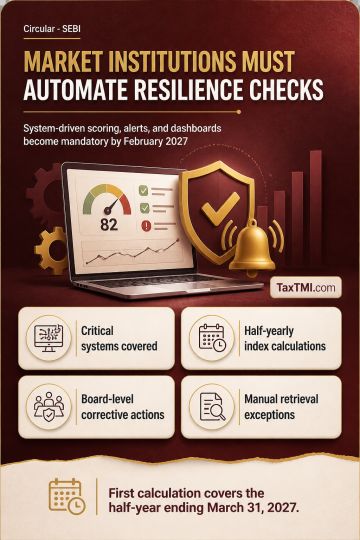
IT Resilience Index requires market infrastructure institutions to automate resilience scoring, early warnings, and continuous service-delivery monito...
Finance Minister announced plans to introduce a new comprehensive Income Tax Bill in Lok Sabha, intended to replace the Income-Tax Act, 1961. Following Cabinet approval, the proposed legislation will undergo parliamentary standing committee review before final implementation. The bill aims to modernize tax administration through a more concise and clear framework, reducing disputes and enhancing tax certainty. CBDT established an internal oversight committee and 22 specialized sub-committees to review various aspects. The reform process includes three critical stages: initial introduction in Lok Sabha, committee scrutiny, and final parliamentary approval post-Cabinet endorsement. This legislative overhaul represents the first major restructuring of income tax law since 1961, focusing on taxpayer clarity and dispute reduction.
Finance Minister announced plans to introduce a new comprehensive Income Tax Bill in Lok Sabha, intended to replace the Income-Tax Act, 1961. Following Cabinet approval, the proposed legislation will undergo parliamentary standing committee review before final implementation. The bill aims to modernize tax administration through a more concise and clear framework, reducing disputes and enhancing tax certainty. CBDT established an internal oversight committee and 22 specialized sub-committees to review various aspects. The reform process includes three critical stages: initial introduction in Lok Sabha, committee scrutiny, and final parliamentary approval post-Cabinet endorsement. This legislative overhaul represents the first major restructuring of income tax law since 1961, focusing on taxpayer clarity and dispute reduction.
Note: It is a system-generated summary and is for quick reference only.
 TaxTMI
  TaxTMI
 of 4828







 Join Channel