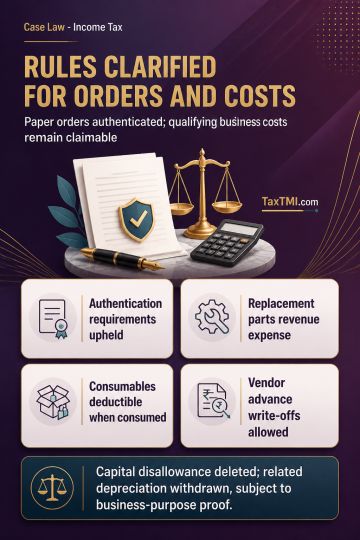
Authentication of paper assessment orders upheld, while qualifying repairs, consumables and vendor advance write-offs remain deductible business claim...
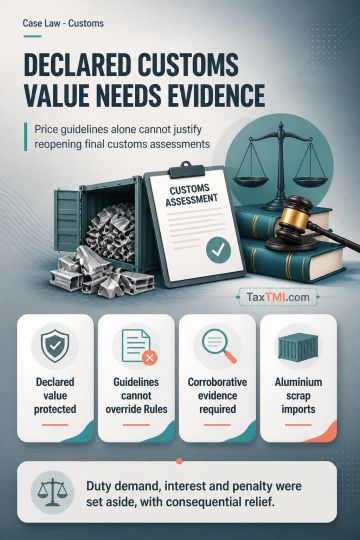
Transaction value cannot be rejected solely on non-statutory valuation guidelines without corroborative evidence supporting reassessment of final cust...
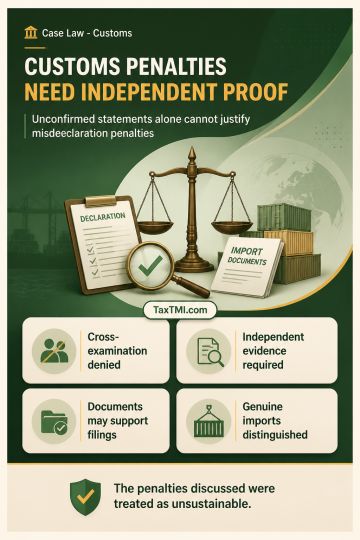
Cross-examination rights and corroborated evidence limit customs penalties for misdeclaration in genuine import transactions involving documented clea...
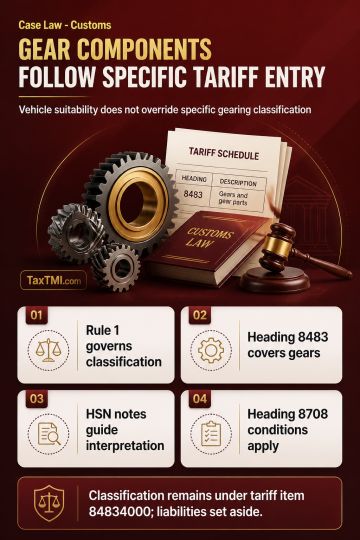
Tariff classification of vehicle gear components follows the specific gearing entry, displacing motor-vehicle parts classification and related liabili...
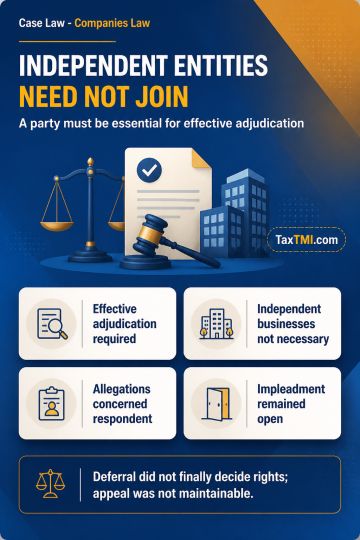
Necessary-party requirements limit impleadment of independent entities, while deferred consideration does not create an appealable adverse determinati...
Page of 4789
Press 'Enter' after typing page number.
441 to 460 of 95769 Results
❮
❯
❯❯
0 / 200
Expand Note
Add to Folder
No Folders have been created
+
Are you sure you want to delete "My most important" ?
Developer directed to refund apartment booking amount exceeding 10% of Basic Sale Price (BSP) without interest to purchaser following cancellation. SC upheld NCDRC's determination that 10% BSP constitutes reasonable earnest money forfeiture, finding original agreement terms unconscionable and one-sided. Court applied precedent requiring clear, explicit contract terms to justify earnest money forfeiture, distinguishing between earnest money deposits and consideration payments. Ruling emphasized that unfair contract terms between parties with unequal bargaining power are unenforceable under Article 14. While forfeiture of reasonable earnest money falls outside Section 74 of Contract Act, penalty-nature forfeitures remain subject to statutory limitations. Appeal partially allowed, modifying interest component while maintaining principal forfeiture limit.
Developer directed to refund apartment booking amount exceeding 10% of Basic Sale Price (BSP) without interest to purchaser following cancellation. SC upheld NCDRC's determination that 10% BSP constitutes reasonable earnest money forfeiture, finding original agreement terms unconscionable and one-sided. Court applied precedent requiring clear, explicit contract terms to justify earnest money forfeiture, distinguishing between earnest money deposits and consideration payments. Ruling emphasized that unfair contract terms between parties with unequal bargaining power are unenforceable under Article 14. While forfeiture of reasonable earnest money falls outside Section 74 of Contract Act, penalty-nature forfeitures remain subject to statutory limitations. Appeal partially allowed, modifying interest component while maintaining principal forfeiture limit.
Note: It is a system-generated summary and is for quick reference only.
 TaxTMI
 of 4789




 Join Channel


 TaxTMI