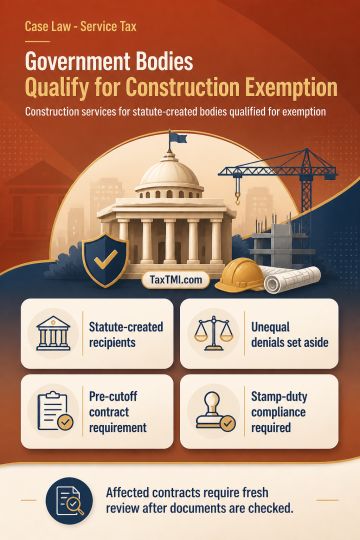
Governmental authority status supports construction-service exemption, while pre-cutoff contract and stamp-duty compliance requires verification on re...
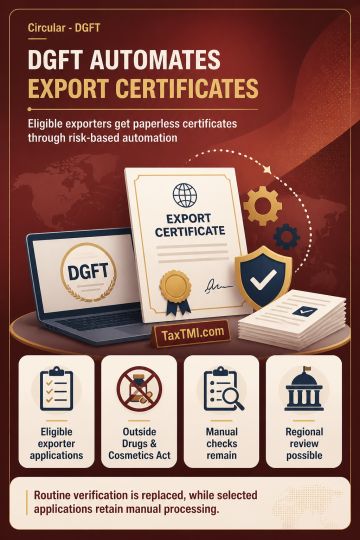
Automated Free Sale and Commerce Certificates enable paperless processing while retaining risk-based manual verification for selected exporter applica...
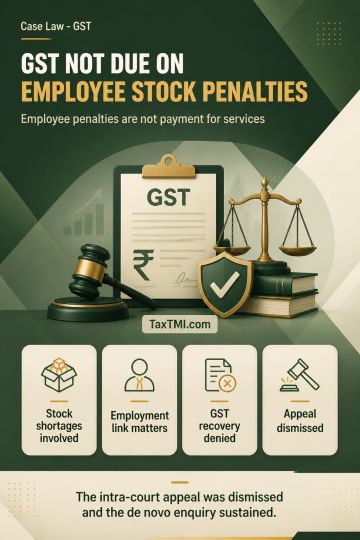
Employee stock-shortage penalties do not constitute consideration for services, preventing GST collection under Schedule II in employment relationship...
Union Cabinet approved a new Income Tax Bill to replace the Income Tax Act, 1961, aimed at simplifying direct tax legislation. The bill, characterized by simplified language and elimination of complex provisos and explanations, maintains existing tax obligations without introducing new burdens. Following cabinet approval, the legislation will be introduced in Parliament and referred to the Standing Committee on Finance. The reform stems from FM's announcement in Budget 2025-26, with CBDT overseeing the comprehensive review through specialized committees. The modernization effort incorporated 6,500 stakeholder suggestions focusing on language simplification, litigation reduction, compliance streamlining, and removal of obsolete provisions. Implementation will proceed through parliamentary deliberation, with the bill's introduction scheduled for the current session.
Union Cabinet approved a new Income Tax Bill to replace the Income Tax Act, 1961, aimed at simplifying direct tax legislation. The bill, characterized by simplified language and elimination of complex provisos and explanations, maintains existing tax obligations without introducing new burdens. Following cabinet approval, the legislation will be introduced in Parliament and referred to the Standing Committee on Finance. The reform stems from FM's announcement in Budget 2025-26, with CBDT overseeing the comprehensive review through specialized committees. The modernization effort incorporated 6,500 stakeholder suggestions focusing on language simplification, litigation reduction, compliance streamlining, and removal of obsolete provisions. Implementation will proceed through parliamentary deliberation, with the bill's introduction scheduled for the current session.
Note: It is a system-generated summary and is for quick reference only.
 TaxTMI
  TaxTMI
 of 4828








 Join Channel


