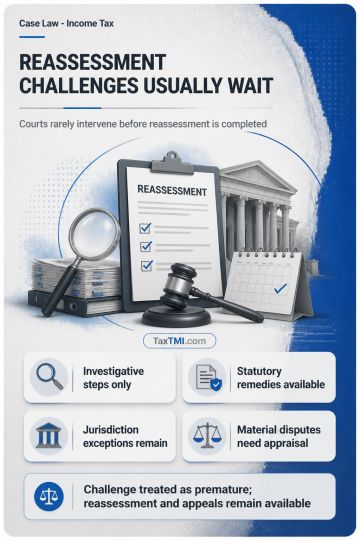
Preliminary reassessment proceedings generally require statutory remedies unless jurisdiction is wholly absent or mandatory conditions are patently br...
Agricultural land classification requires cumulative factual indicators, while industrial-purpose land and absent agricultural use defeat reinvestment...
Composite residential flat exemption upheld where supplementary agreement merged adjoining units and additional evidence supported the taxpayer's inve...
The proposed new Income Tax Bill aims to replace the Income Tax Act 1961 with a modernized, simplified framework that maintains revenue neutrality. The legislation will streamline the current 298-section statute by eliminating obsolete provisions, removing redundant amendments, and simplifying legal language for enhanced comprehension. Key objectives include reducing litigation through clearer statutory interpretation, implementing technology-driven compliance mechanisms like pre-filled returns, and consolidating direct tax provisions in a more accessible format. The Bill, scheduled for Parliamentary introduction during the Budget session, will undergo Standing Committee review. While maintaining existing tax rates and structures, the reform focuses on procedural simplification rather than substantive tax policy changes, preserving the established direct tax framework while improving its administrative efficiency.
The proposed new Income Tax Bill aims to replace the Income Tax Act 1961 with a modernized, simplified framework that maintains revenue neutrality. The legislation will streamline the current 298-section statute by eliminating obsolete provisions, removing redundant amendments, and simplifying legal language for enhanced comprehension. Key objectives include reducing litigation through clearer statutory interpretation, implementing technology-driven compliance mechanisms like pre-filled returns, and consolidating direct tax provisions in a more accessible format. The Bill, scheduled for Parliamentary introduction during the Budget session, will undergo Standing Committee review. While maintaining existing tax rates and structures, the reform focuses on procedural simplification rather than substantive tax policy changes, preserving the established direct tax framework while improving its administrative efficiency.
Note: It is a system-generated summary and is for quick reference only.
 TaxTMI
  TaxTMI
 of 4830














 Join Channel


