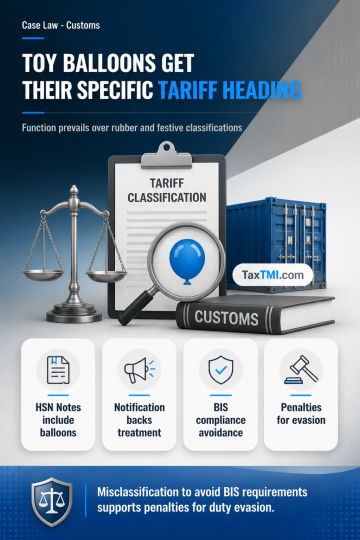
Toy balloon tariff classification: functional heading prevails over residual rubber and festive article headings, supporting penalties for deliberate ...
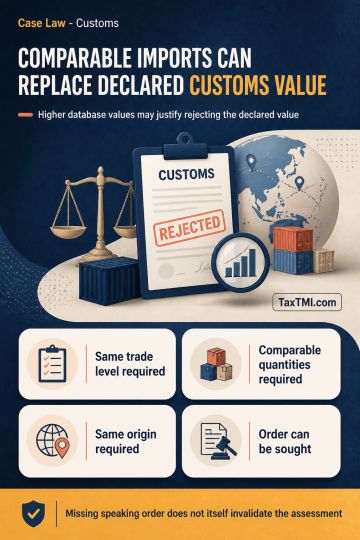
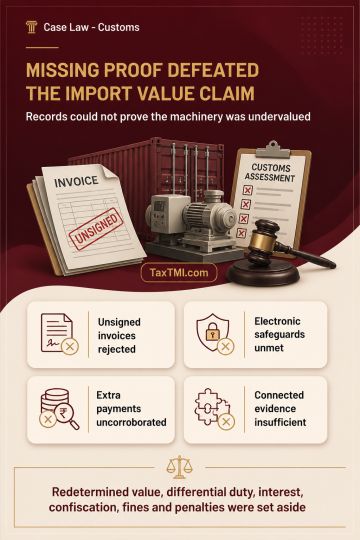
Customs valuation using comparable contemporaneous imports can displace declared value, while missing speaking orders require pursuit before competent...
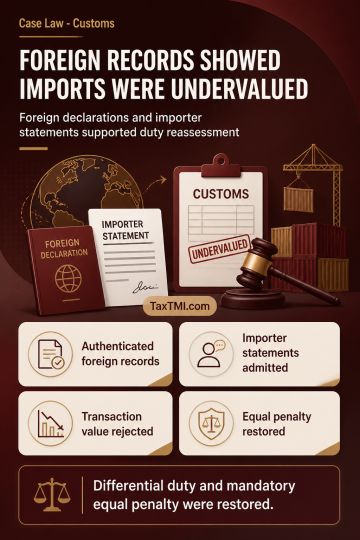
Foreign customs declarations and importer admissions established undervaluation, supporting sequential value redetermination, differential duty, and m...
Customs seizure safeguards prevent detention-based limitation avoidance and invalidate provisional release conditions for imported vehicles under an i...
Page of 4828
Press 'Enter' after typing page number.
361 to 380 of 96556 Results
❮
❯
❯❯
0 / 200
Expand Note
Add to Folder
No Folders have been created
+
Are you sure you want to delete "My most important" ?
The Dept of Revenue amended the Customs (Import of Goods at Concessional Rate of Duty or for Specified End Use) Rules, 2022 through Notification 07/2025-Customs. Key modifications include extending reporting periods from monthly to quarterly basis and prolonging certain compliance timelines from six months to one year. The amendment introduces definition of "quarter" as three consecutive calendar months ending March, June, September or December. These changes affect various compliance requirements under rules 6, 7, 8, 9, and 10, including submission of statements, reconciliation reports, and maintenance of account records. The amendments take effect from February 2, 2025, aiming to streamline administrative procedures and reduce compliance burden for importers.
The Dept of Revenue amended the Customs (Import of Goods at Concessional Rate of Duty or for Specified End Use) Rules, 2022 through Notification 07/2025-Customs. Key modifications include extending reporting periods from monthly to quarterly basis and prolonging certain compliance timelines from six months to one year. The amendment introduces definition of "quarter" as three consecutive calendar months ending March, June, September or December. These changes affect various compliance requirements under rules 6, 7, 8, 9, and 10, including submission of statements, reconciliation reports, and maintenance of account records. The amendments take effect from February 2, 2025, aiming to streamline administrative procedures and reduce compliance burden for importers.
Note: It is a system-generated summary and is for quick reference only.
 TaxTMI
  TaxTMI
 of 4828









 Join Channel